Showing posts with label art. Show all posts

Thursday, May 14, 2009

How to Make a Magic Carpet

The study of Persian rugs is an interesting way to get into Persian history and Islamic culture. Why are Persian carpets so beautiful? In a culture where iconography is immoral, a functional object like a rug is a place where art can be expressed "legally." Like calligraphy, Persian carpets are art in the guise of a necessity. Given the significance of these rugs to the culture from which they come, it's no wonder they are sometimes portrayed as magical.

Here are a few things we learned about while studying Persian rugs: symmetry, the types of designs (geometric, curvilinear, pictorial), the elements of a rug (border, central medallion, repeated motifs), child labor laws, how to value a rug based on knot count, the difference between natural fibers and manmade fibers, and more.

Project materials:

Large canvas rectangles
Crop-a-dile or other awesome hole-puncher
Lace-weight yarn/thread in different colors
Poster paint and brushes

Preparation:

Punch holes in the short sides of all the carpets, about 1/2 inch apart. You are going to need a serious, no-kidding hole punch to get through canvas. I used a Crop-a-dile.
Cut the thread into pieces about 10 inches long. Deep rich colors are best.

Step One: Fringe


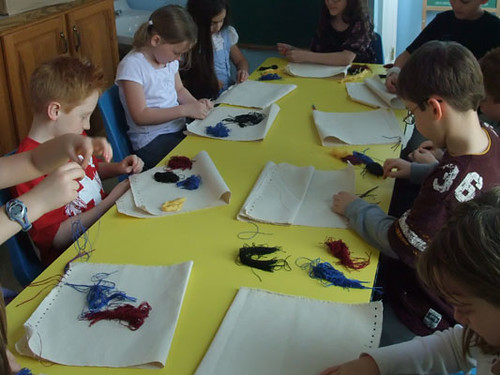
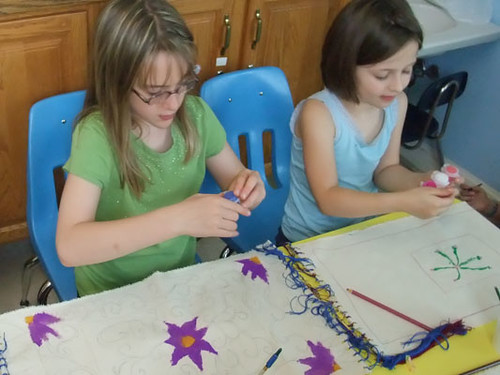
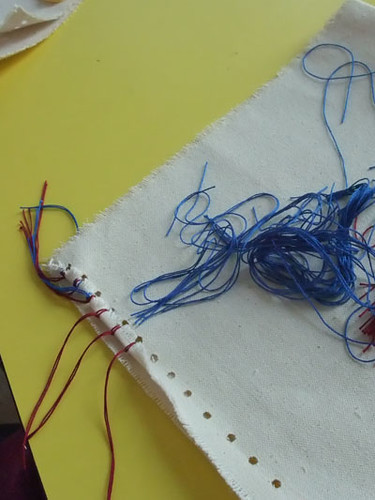
Give each child a choice of thread colors and encourage them to work in patterns. They can use a simple knot to create their fringe. Make a loop in the center of the thread, push the loop through the hole, and then thread both ends through the loop. Pull tight. You can fold over the edge of the fabric as you go to create a smooth edge.


Step Two: Paint

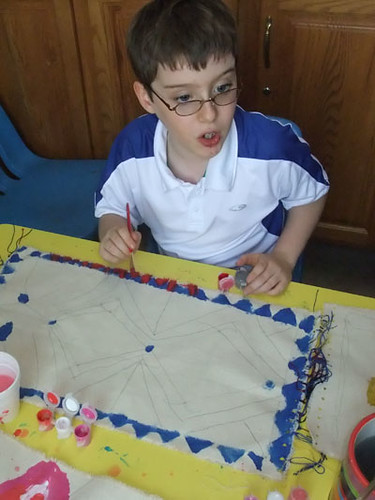
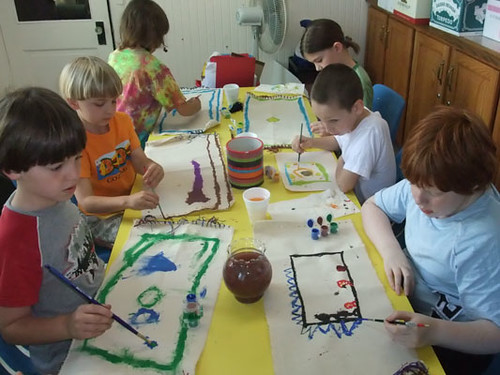
First have the children sketch their ideas with a pencil lightly so they can erase and redo it if they're not happy with it. Make sure everyone remembers to put in a border, a central medallion, and then repeated motifs.


The kids took home some interesting work! Painting on the canvas was challenging for a few, they needed reminding to keep a lot of paint on their brushes. However, making the carpets led to some interesting discussions about what the carpets mean to the people who make them. Here is the class singing a Persian folk song while they worked. They started singing spontaneously, then of course I had to run get my camera and have them do it again!


What class is this? My elementary literature class at Norfolk's premier co-op of extreme homeschool awesomeness, Homeschool Out of the Box.

Wednesday, August 20, 2008

How to Make a Duct Tape Hat

Want to learn to make an awesome, waterproof, colorful, duct tape hat, using two rolls of duct tape and nothing else!? Welcome! This project is part of the Vote for Me! Elections Unit Study hosted here at Little Blue School. All the lucky people who are attending the political conventions are going to be wearing those crazy, ridiculous, fashionable hats, so I decided to get us in the mood with duct tape hats. My dear friend Lori, adored playmate of my childhood, brought her kids over today to play. They are also homeschoolers! Naturally, I roped them into some hatmaking, particularly Eden, who is 11 and handy with the duct tape.

Here's our result:
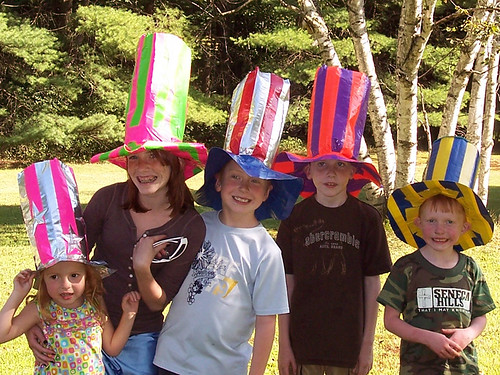


So, how did we get there?

Materials:
Duct tape in many colors. We used Duck brand which comes in purple, orange, blue, red, chrome, pink, aqua, yellow, and other silly choices. I used approximately two rolls per hat. Some rolls have more on them than others. I had no problem getting a whole hat out of two small rolls, with leftovers.
Scissors you don't care too much about. They will get sticky.

I can think of a million variations to this hat, but here are directions for my hat, my method:

1. Build the Brim Square. First, you build a square from which to cut the brim.


Lay down a piece of tape, about 18 inches long, sticky side up.
Next tear off another piece of the same length. Lay it on the first piece, sticky side down, staggered halfway up.
Now you have two pieces of tape stuck together, with half the sticky side exposed on each side.
Turn the piece over to expose the sticky part of the tape you just added.
Stick another piece on, same length, sticky side down, over that one.
Continue until you have a square.

By laying each piece of tape exactly over the other, arranging these two-sided strips next to each other, and then laying another layer of tape perpendicular to the first layer, to join them, you can create a stronger piece. Like I said, there are other ways, but this was my way.

2. Cut the Head Hole. When you have built a square, cut a circle out from the middle of it.
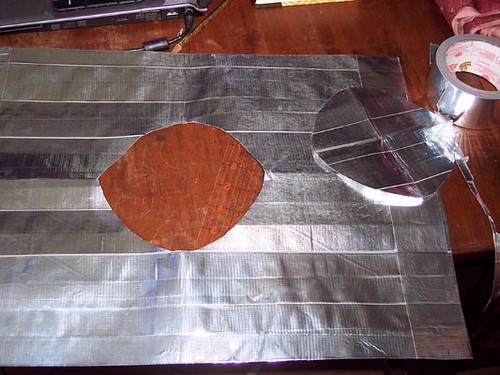


You'll need a circle that will allow your head to go into it, but be careful of making it too loose. Duct tape is actually pretty stretchy. To get a circle, fold your square in half and then cut a quarter circle away from the center point, then unfold. If you start with a 3.25 inch quarter circle, you will probably be in the right neighborhood. Big math points to older students for figuring all this out exactly. Fit it onto your head to make sure it will go:
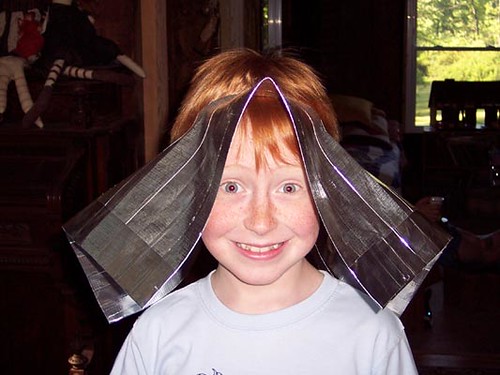


3. Create the Crown Rectangle. Now it's time to make the crown. Figure out how high you want your hat to be. I did about 12 inch strips. Your vertical strips will be joined together in exactly the same manner that you joined strips to build the brim. If you want stripes, alternate colors -- two blue (one in the front, turn, one in the back) then two red (one in the front, turn, one in the back)

Here's me making the striped crown of Sadie's pink-and-chrome hat:
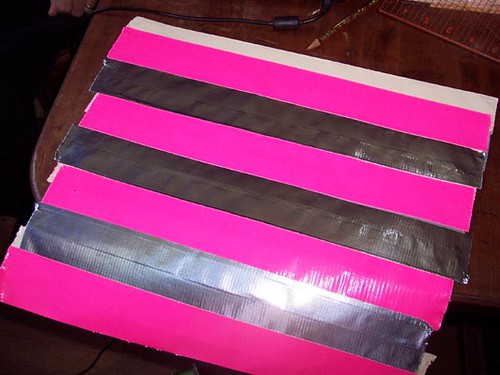


4. Join the Crown Tube. When the crown has been built up to a length that will wrap around your head and fit approximately into the hole you made in your brim, finish it by joining the two ends together.

Here I am with the "stovepipe" part of the hat, measuring it against the hole in the brim, while Dan explains something about trading to me:
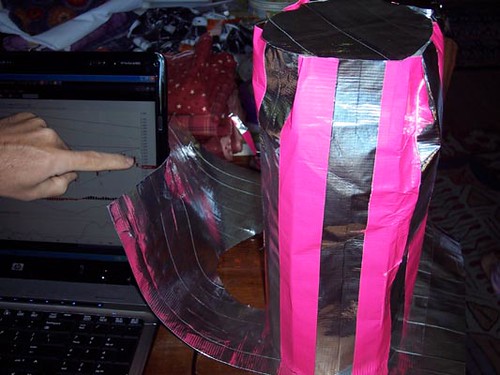


Here's Eden measuring her crown against her brim, checking to see if she needs to add more strips:
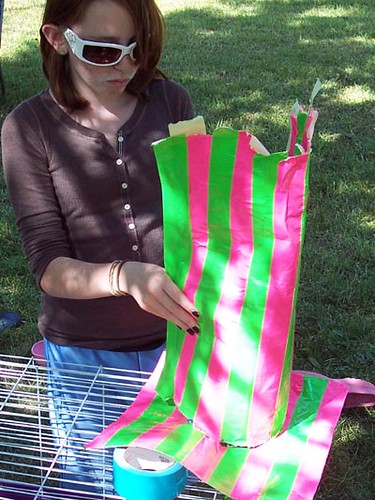


5. Cut the Tabs. Now cut slits in the bottom of the crown, about two inches long, all around the bottom of it. These will become tabs that attach to the brim. This is best illustrated in a picture I took of Eden making her hat:
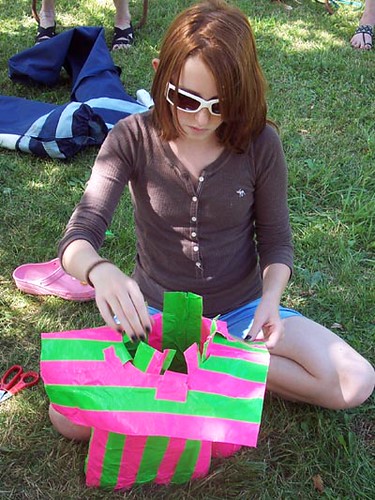


6. Connect Brim to Crown. When you have your tabs cut, tear as many 3 inch strips of tape as you have tabs, and stick them to something closeby, like a table edge or your leg, so they'll be handy. Start by taping down one tab, then do the tab opposite, then the tabs between, and work your way around. So, do the north tab first, then the south tab, then east and west, etc. This will keep your project even. It's a good idea to try on during this process so you can gather it in or stretch it out a bit, as needed. Tape all your tabs down firmly. If at any point the hat becomes too big, create a gather and tape it down. If it is too small, cut the crown apart, add more tape, tape it back together, and you will *never know* there was a problem. Duct tape is awesome!
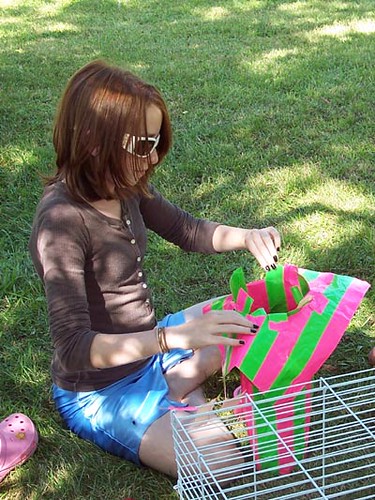


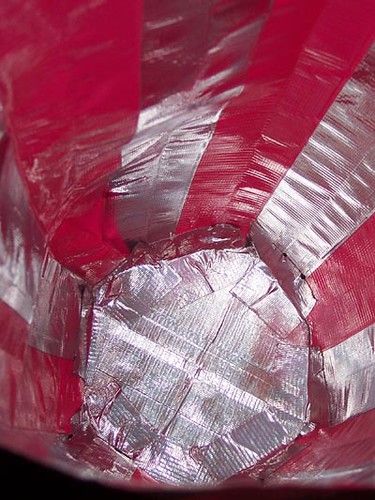
7. Attach the Top. The only thing left is to make the very top of the hat. If you still have the piece you cut out of the brim, you can use that to finish the top, or you can create a new piece using the same strip-on-strip method, and cut it into a circle. It's not necessary to make it perfect at first cut, you can trim it to fit later, after you tape it in. Attach it with tape strips inside the crown where it won't show:


8. Embellish. Now you can trim the brim into whatever shape you like. Zig-zag, circle, scallops, or whatever. You can cut out embellishments and tape them on, add a hat band, flowers, whatever you like. We added stars on this hat to turn it from this:
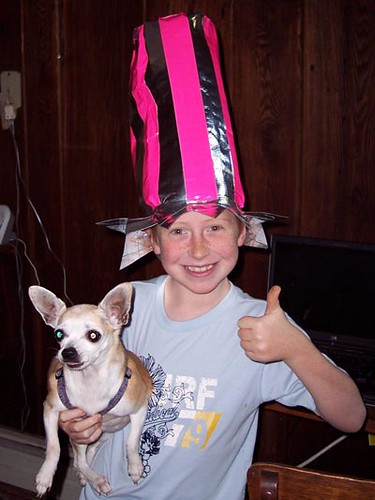


To this:


Eden rolled her brim to create a cowboy-hat-like effect:
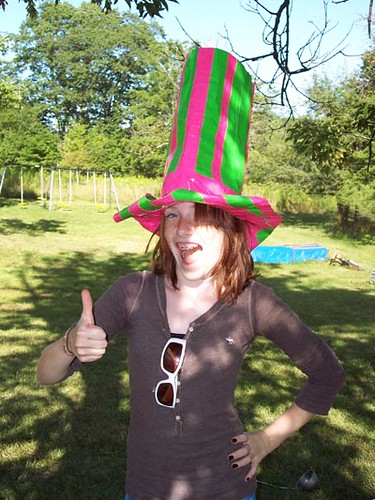


That's it! There are more pictures in my Flickr Set but I can't resist posting a few more here. Any questions, please email me. If you do this project, I would love to see the results! Stay tuned for more Vote for Me materials, and happy campaigning!

Benny's hat:


Jordan's hat:
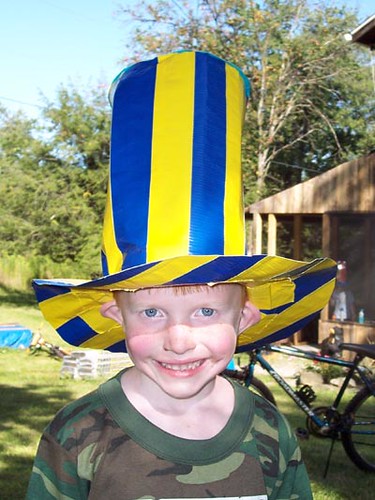


Cameron's hat:


Happy Homeschoolers:
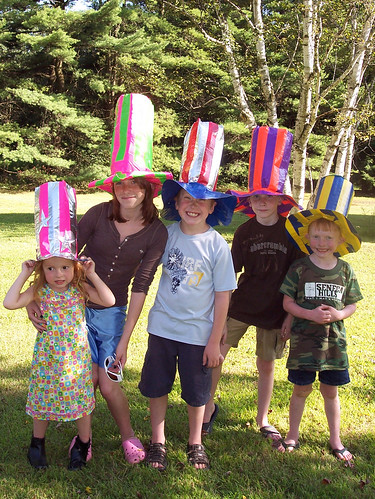


Is this your first time at Little Blue School? Welcome to the blog! I hope you'll stick around and visit some of my other posts for more homeschooling ideas, projects, songs, and crafts. If you found this page helpful, would you bookmark it on your favorite social bookmarking site? Thanks!

Wednesday, July 30, 2008

Hidden Poetry Project

One challenge in teaching very small children to write poetry is that they don't really know what it looks like -- its literal or even imaginary shape. Children hear stories of a certain length and "shape" regularly. There are reliable forms and predictable elements that a child can make their own. Once upon a time, there was a princess. Once upon a time there was a lonely shepherd. In the end, the monster was defeated and the princess married the prince. From that jumping off place, a child can bring in the talking potatoes or the underwater bicycle or whatever they bring to the form, because they mostly know what to expect, and what is expected of them.

Poetry is different, because its forms are so varied. There are traditional pieces that look very organized and rhyme and maybe fit on a page in a sonnety way. There are more freeform pieces with different line lengths and interesting breaks and punctuation. A child encouraged to write a poem may not immediately know the scope -- two lines, twenty lines, twenty pages? This project was a way that my kindergardener could visualize her poem and get a sense of the space she was going to fill, before she wrote it.

I found this cool painting technique on Scrumdilly-Do and decided to modify it into a poetry prompt for teaching the junior class in Phi Bensa Zoe Academy. Phillip is five, Sadie is four, and they both did really well with this.

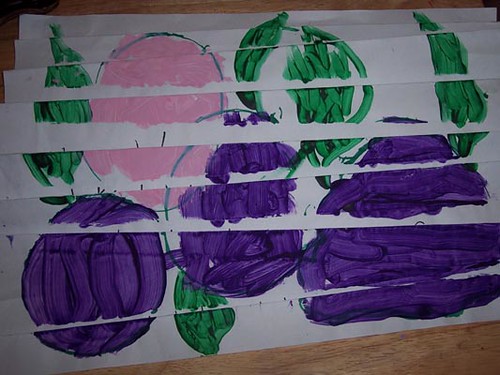
If you click on this link for the painting idea, you'll see very excellent how-to pictures, much much better than mine. The basic idea is that you fold up a big piece of paper in a staggered accordion fold. You just put little ripples in it so that when it all lies flat there is a new surface for the paper , with lots of hidden little strips folded up into it. Then you paint on this new surface:


Then you let it dry for a while and stretch it out:


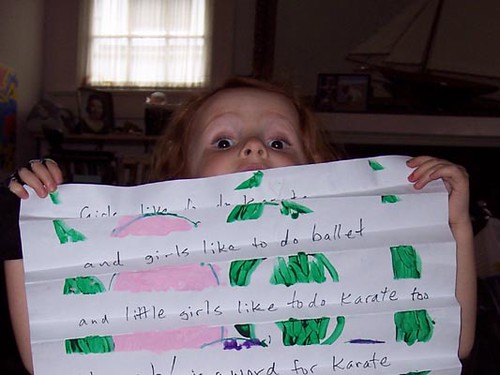
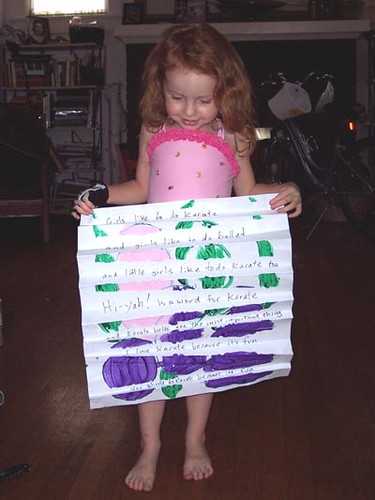
This is where the poetry comes in. After the kids had these neat staggered strips of color and these white strips in between, I had them dictate a poem to me, and I wrote each line in a white strip. Very cool. They could see how many lines they needed and about how long the lines would be, so I think it looked somehow doable for them. Anyway, they did it:


Here's Sadie with her finished project. It is a poem about ballet and karate and I think the theme of it is that she really likes to leap around the house yelling and making muscles at us but that doesn't mean she can't still call herself a ballerina.


The coolest thing about this is that you can fold the paper back up, hiding the poetry, and it becomes a painting again. It's a secret poem. Possibly a magic poem. The magical properties have not yet been tested yet. If I wake up and the sink is empty of dirty dishes, I will let you know. It certainly was cool to put it back together, and unfold it, and fold it up again, etc.

Many skills involved here: folding, paper-clipping, painting in one direction (you want to paint in strokes perpendicular to the folds so you don't get any into the white strips) Sadie enjoyed herself, and so did Phillip. So, good for kindergarten. But would this exercise have value beyond the paste-craving years? An older child, or even an adult, might find this an interesting way to integrate writing and art. The pre-defined line limit could be seen as a constraint or a challenge -- kind of like making yourself write a sestina or even a haiku. Give it a try and see what you come up with. And props to Scrumdilly-do again.

We're part of the Book Arts Bash. Are you?

Wednesday, January 30, 2008

Dinosaurs

Sadie has been on a major dinosaur-drawing tear. We have a book that shows the kids how to draw different things step-by-step. I'm sure it came from a Wisconsin-based relative, several Christmases or birthdays ago, and it's now in full use. Benny and Sadie have both been drawing things from it, and Sadie is particularly attached to drawing a particular dinosaur. She draws it, she narrates a big long thing about it, and then she cuts it out, leaving scraps of paper all over the floor. Here is one of her dinosaurs. This one's narrative involved stamping around in the mud a lot:


Tuesday, January 22, 2008

The Awesomeness of Benny

Benny and Sadie have been watching Ratatouille. This was a movie that didn't particularly delight them in the theater. I remember thinking that the beautiful imagery of it was lost on them, and that it was another movie with kind of sophisticated adult themes -- about having confidence to step outside your comfort zone, or about believing in someone in spite of their unlikely exterior, or about giving credit where credit is due, or something.

Turns out, now that they have the DVD, they just like the funny rats. Yay!

Benny has been trying to make a chef's hat, or "Toque" as he says, for Sadie. He yearns for her to wear a chef's hat of his creation, and toodle around her little toy kitchen with the Folkmanis rat puppet inside her hat. This dream of the Folkmanis puppet inside Sadie's hat playing "little chef" has resulted in several mishaps, including one of his ears being burned half off in the toaster oven (the puppet's ear, not Benny's) and one chase scene involving Sadie, Benny, and a paper toque with Benny saying "I just want to tape it on her head!"

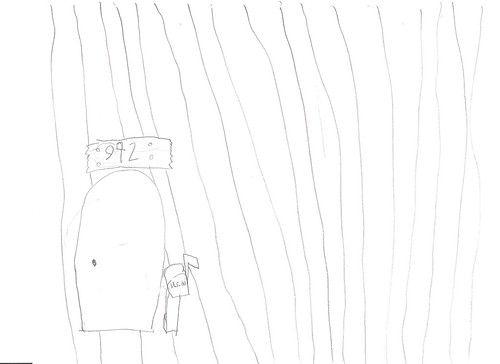
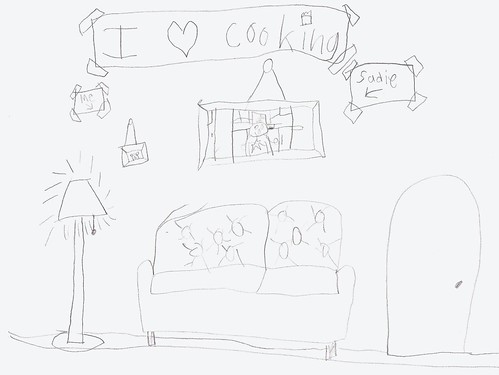
I scanned in his drawings for the most recent version of the toque. The outside has the lines on it, and the little door. The inside is furnished.


The rat has hung a picture of himself (labelled "Me") and his buddy (labelled "Sadie") although he seems to have taped the labels to the wall. He also has a pretty nice tufted leather sofa! Oh, I do love Benny so much.

Tuesday, October 23, 2007

Stockley Gardens Arts Festival

We've been going to the Stockley Gardens Arts Festival for a several years. Since Benny was four and screeching out Twinkle Twinkle Little Star on the children's stage with the rest of the little squirts in his first year class. Last year he played his violin at the spring festival, but last weekend we missed the fall performance because we were on our way home from Boston.

On Sunday, safely back from our trip and eager to enjoy the hot Virginia weather after our stint in the frozen north, we walked down to the festival to look at the art and pat all the dogs.


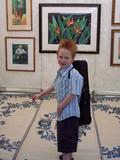
We saw lots of art. Here was my favorite canvas (the one on the right):


Benny got his face painted to look like Leroy. Very effective:


Sadie and Benny both had some shaved ice. Benny invented a watermelon/chocolate combo, which sounds nauseating but was actually really good, the remains of it that I was asked to finish anyway. Sadie went with a more traditional strawberry:


So, I put it to you. Is this not an acceptable substitute for the festival carnival death-trap situation? Where they ride on the wooden roller coaster with the squivering nuts and trembling bolts? Where they sit on the creaking ferris wheel which has to be held up on one side by a local farmer? The one with the dancing bear, half eaten with mange, straight from Russia, who's wearing a frilled collar stained with his own rabid drool and the blood of his most recent victim? And eat chocolate tacos made out of silicon and drink lemonade from actual human skulls? Okay, not the Russian bear, but you get the idea. Can I not count this as our carnival experience for the season? There were painted faces, frozen treats, dogs galore, and Benny even got to do his crazy dance (inexplicable, and I didn't video it, unfortunately) in front of a big audience at the "folk singers with guitars" stage.

I'm counting it. Pungo Strawberry Festival, you're dead to me.

Thursday, October 12, 2006

Neighborhood Art Walk

A local neighborhood puts on an annual "Art Walk" where local artists put their work out on their front porch. Some of the work is for sale, some is for display, but the most fun is just walking around, talking to people, and seeing what creative people are behind the doors you drive past every day. Last year after we went, Benny came home and asked to be an artist, so I bought him a few canvasses and some "real" paint, and let him have at it.

This year he showed his work, and sold signed prints that I had made from photographs mounted on cardstock. His prints sold out in two hours, and one was even bought by the guy that owns a nearby restaurant and he hung it on his wall!

Here's our little set-up in the back of our van:


Here's a picture of the painting that people liked the best:


Benny loves to talk to people, so he had a really great day. Here he is talking to a customer:


And here's one final picture, of one of our friends who stopped by and bought *two* prints of Benny's work. Why, that cost a *WHOLE DOLLAR*!!! :D


Benny also gave away free visors he had made, and sold little drawstring bags and baby hats that I had made, and all of our proceeds went to support the next Community Bike Ride.

It was a good day.

Thursday, September 28, 2006

Homeschool Teachers are Learning Too

I recently got asked this question: How are you teaching your son art when you don't know anything about it?

Good question.

Most homeschooling moms are not experts in art or math or French or the history of Australia or how pandas digest bamboo. A lot of us have degrees in one thing or another, I happen to have a couple of degrees in literature. Helps when we get to 19th century American fiction, but a fat lot of good that does me when we're learning about art!

So what do we do, when we're out of our element, and our kids need us to know what we're doing? Several choices:

1. We study hard and stay one step ahead of our kids. This happens mostly when a family is following a set curriculum. Mom may be teaching Junior calculus and she may be learning calculus the night before, real quick, before Junior gets to that lesson.

2. We learn right along with them. This happens more in a child-led learning environment, where we're following the kid's interests. What kinds of things do you want to learn about, Junior? Okay, let's get some books from the library, look it up on the internet, and delve in. A child who sees his mother actively seeking informationn, getting excited about learning right beside him, being open to new things, is getting a fine example of how learning should happen. Mom's not learning because she has to, she's not learning because someone is making her, she's learning because she wants to. That's a valuable lesson. When I was a kid, my parents read constantly, and I learned by example that reading was great entertainment. By watching them, I learned what to do. So when I'm struggling through my Spanish lessons with Rosetta Stone, or looking up Galapagos iguanas on the internet, my child is seeing how learning can be fun and exciting, when no one is making you do it.

3. Another choice is to hire someone to teach your child who *is* an expert. Benny has a swimming teacher, a violin teacher, and a karate teacher -- these are things that we have decided he really needs an expert to teach him. So we go find an expert. If he gets very interested in painting, we're fortunate to have an art teacher in the family, as his Ahno has an art degree and has taught it at various levels in and out of traditiobnal school. So, on that, we're covered. We have friends who take art lessons at the Children's Museum in Portsmouth. Or at the SOFA art camps. There are lots of ways to outsource this one! :D

So let's return to the topic of art and the way we're dealing with it this week. What happened at the museum on Wednesday?

We both wandered around the galleries. I let him lead. He knows pretty much where everything is. Our challenge, our mission, as we discussed it on the way there, was to look at the brush strokes and see how the artists used the shapes of their brush strokes to form the pictures.

Benny pointed out, about half way through the impressionist gallery, that when the brush strokes are bigger and more obvious, the paintings are less realistic. When the brush strokes are smaller, the paintings look more real. I used my fresh info about the Mona Lisa to inform him that the thickness of the paint matters too, so we compared that painting of the table laid out with silverware (very realistic) to the one of the Harlem River in winter, which is more abstract and where the artist used really thick paint.

After we had this revelation, we went on to the modern and contemporary galleries, where Benny visited his favorite painting, shown below. He rushed past it quickly, looking at it out of the corner of his eye, back and forth, back and forth, and told me that it looked good to him when the pattern mixed together because it was going by fast.


He also studied the installation with all the TVs shaped into a king, and we talked about how art doesn't have to be paint on a canvas or a bronze sculpture, etc. We left when the kids were ready to leave, and went out to look at the fountain, which is always Sadie's favorite part.


Benny went home and started painting another canvas. He showed me how he was using brush strokes to make shadows on the water. I'm not entirely sure how that works, but I'm glad he's experimenting with it and I'm glad he learned from his trip to the museum.

I'm so glad this question was asked, because think a lot of people are wary of homeschooling for this reason. They think, "I'm not an expert, I can't possibly teach my child everything he needs to know." The truth is, you can. First grade art isn't really a good example, because of course anybody can handle the curriculum here -- identifying primary colors, zig-zag and spotted lines, geometric and organic shapes, size relationships, creating a piece of art inspired by a poem, etc. You can see all the standards of learning for visual arts for Virginia here. If you can't stay on top of that list, maybe you really shouldn't be homeschooling your kid! ;D Just kidding. But seriously. I think Benny's okay, at least for now. If we get into serious stuff, and I'm over my head, I have access to experts to help me out.

You raise a good question. And part of what makes homeschooling so interesting, for many of us who do it, is that homeschooling is learning too.

Wednesday, September 27, 2006

Art Research

Yesterday Benny painted with acrylics on canvas, so today we're going to the art museum.

I bought Benny a couple of canvasses to paint, since he's going to be "showing" in the Colonial Place Art Walk that's coming up in a couple weeks. Last year's art walk was really great -- we bought some jewelry and pottery and it was fun walking around checking out everyone's porch. Here are some pictures from the Colonial Place River View web site. Benny really wanted to be a "real artist" and show some of his painting, so this year we're going to go for it.

Here's a picture of him painting yesterday:


I am completely in the dark when it comes to teaching him techniques of painting. I'm about as artistic as a sick goat. So, today we're going to go to the Chrysler Museum and see if we can notice some ways that artists use different brush strokes to create effects.

Dad pointed us to a story on CNN this morning about the Mona Lisa, which has recently been examined with special infrared and 3D technology. Apparently, Da Vinci painted with such thin paint that the brush strokes are invisible.

Anyway, off to absorb some culture, as soon as he does a tiny bit of math and practices his violin. :D Always good motivation -- as soon as you _____ we can go look at some art!

Thursday, July 27, 2006

Masterpieces from an English Country House: The Fitzwilliam Collection

Have you seen the Fitzwilliam Collection at the Chrysler? I'll give you a few ideas for preparing your children to have an interesting experience at the museum.

Okay, it's not like Masterpieces from an English Country House: The Fitzwilliam Collection is going to change your life or rearrange your laundry room or open your eyes to the world of... giant books about birds, for example. But it is an interesting an eclectic exhibit, and something my children found enjoyable. The collection displays some interesting artifacts from the a stately home in England, collected over a family's long history.

The exhibit is divided into sections based on the centuries. The first room introduces you to the house with photographs of the exterior and interior. Then there are the portraits. Look for the Anthony Van Dyck portrait of Thomas Wentworth and his very cool dog. If you go to the link above, you can show your child a picture of this portrait before you go. The next room features work by George Stubbs. Check out this link for lots of pictures of his paintings. His style of drawing horses has been copied often, but not so much his penchant for painting them being attacked by wild animals. Interesting man, that Stubbs.

The next room is mostly about enoooormous books: Audobon's _Birds of America_. They can't turn the pages, but the kids will likely be impressed by the scale of these massive volumes.
Then there's some religious art, including a triptych that Benny really loved, and some other more recent family acquisitions. Don't miss the black and white photograph of everyone out in front of the house with the King of England, on your way out. I guess when the King comes over, you want to snap a few shots before he toddles off.

How to make this exhibit interesting to kids? A little preparation will help. When we're going to see something new, I like to make a little "treasure hunt" for Benny to use to seek out things I want him to notice. Then when we're in the exhibit, *he* can point things out to *me*, which is much more exciting and satisfying than the other way around. This works for lots of different experiences, from ballet to boat trips. It also helps to learn a bit about the artists ahead of time, like Van Dyck and George Stubbs for example. Or Audobon.

Here are a few lesson ideas for after the trip:

1. Create HUUUUGE books with wrapping paper or butcher paper. Make a field guide to birds in your backyard, or another type of animal entirely. Why would someone want to make a huge book?
2. Take a digital camera and photograph your house's exterior and interior as if you're illustrating a magazine spread. What elements do you want to highlight or hide? (Hide my laundry room. Please.)
3. Create an art exhibit from items in your house. You can pull your art objects into one room, if you want, for display, or you can leave them where they are and make plaques to describe their origin and significance. You can highlight your own artwork, or artwork your family has purchased, or certain books you like. Create a tour guide pamphlet for visitors to your exhibit. Or make a Podcast, like the museum did for their "open house."

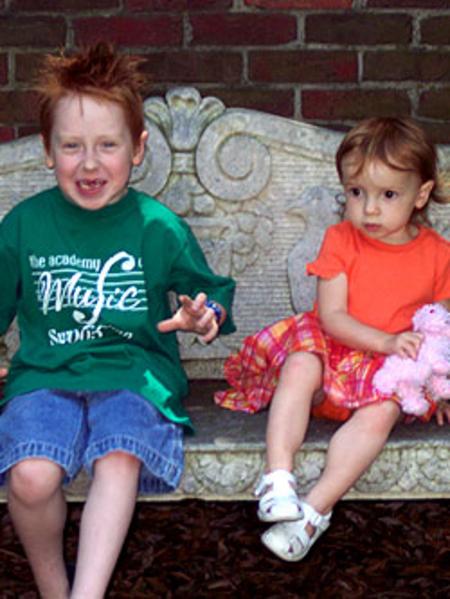
Have fun at the museum! Here are my kids in the garden outside after their trip:

Saturday, May 20, 2006

Art and Joy at Stockley Gardens

First he likes art, and now he's using his violin to make music instead of to pick his nose, scratch his ankles, and dig little holes in the stage. Next he'll be eating his breakfast with a fork, and wearing his underpants on his butt. What kind of mixed-up crazy world am I living in? Is my child maturing at last? Or is this a phase, and we can go back to the old way next week? You know, the old way, where he played the wrong song at the wrong time and then wandered off the stage to pick a daisy or tell a stranger that he likes Hondas, while the other kids all played Twinkle.

Every time the Arts Festival takes over Stockley Gardens, the Suzuki students of STAHR take over the stage. They are, it cannot be denied, cute. The sight of all those little darlings, sawing away on their fractional violins, is guaranteed to make you smile, if not weep copiously, like I do. I juggle the phone camera and the video camera and the still camera, and the baby stroller, and people say, "When did he start playing?" and I say, "He was three," and they can't believe the violins come that small. Usually Benny gets up and plays his solo backward or falls off the stage or something. This year he was dramatically civilized.

I wish I could say I miss the old days, when other parents thumped me on the back sympathetically and said, "Well, he is very entertaining!" Of course, those days will probably be back. I can't dare to hope we have turned an actual corner. It must be a phase. I won't let myself believe otherwise.

You can't see the Suzuki kids tomorrow, because they already played. But you can go and see the art. Where else can you walk around on a sunny day and view interesting art while eating Ben and Jerry's, or even that difficult looking nightmare chicken part that I saw smoking half-cooked ona giant grill today? It's happening tomorrow until 6pm. It's free, it's fun, and it's probably safe to eat by now! You can bring your dog.
Wednesday, May 17, 2006

What Small Boy Doesn't Love Art?


Last fall's trip to the Chrysler Museum climaxed in my son’s declaration that he was going to vomit. He usually claims total health, even in the face of crippling virus, so he won’t miss any of his stuff. He would soldier on, with his head on fire and his stomach exploding, to attend karate for example. I think he’d have to be actually decapitated, to give up on that one. On this occasion, however, he complained, and he was actually looking kind of green. I believe I went so far as to empty one of the baby’s cracker-filled ziplocs in case I needed to enlist its services. Not a good day. He said solemnly that it was caused by, “All the paintings.” Who can say?

Given the outcome of our last trip, I brought it up again with hesitation. But this time was different. I told him, Benny, we’re going to the art museum today, to see the impressionists. And he said, and I quote, “Oh boy! The art museum! Hooray!” It may have been a moment unique in history. It certainly was unique in my experience.

What a change six months can bring about! He sat and gazed at the pictures. He actually utilized those benches you’re supposed to sit on to make your gazing more serene. He pointed out things to me in the pictures, instead of the other way around, and he remembered his favorite painting, the big stripey one in the contemporary section. (Shabazz by Gene Davis) He is convinced he will find a pattern in it. Maybe he will.

To what can I attribute this transformation? Maybe just his age. Maybe he was just in a good mood. Or maybe familiarity breeds respect, and the past trips, taken at a brisk pace, with no pause to reflect or express any discontent, were actually serving a purpose. He recognizes his favorites. He notes new things he hasn't seen before. He looks up at that fabric in the atrium and kind of owns it. He knows it. And really, that makes sense. If he'll watch Wallace and Gromit 47 nights in a row, enjoying each repetition more heartily than the last, wouldn't he also enjoy repetitions of the old masters? Of course.


Here's Benny's copy of Emmanuel Lansyer's "Portrait of Gustave Godard." The Impressionists Gallery on the second floor has a drawing station where you can use crayons, colored pencils, and other tools, along with the paper and clip boards provided, to sit and copy one of the paintings you see. You can view him in the act in the picture at the top of the post. A gentleman we met in the museum had just copied Portrait of Lucy Lee-Robbins, and showed it to Benny, who was inspired.

The point of our trip this time was to say hello and goodbye to the impressionists on their way out, but we also got to see the Masterpieces from an English Country House. Next time, I’ll review that exhibition, and give you some tips for taking children through it, and of course prepping them beforehand so they can anticipate what they will see.