Showing posts with label homeschool science. Show all posts

Sunday, December 13, 2009

SKS Science: Science Supplies for Homeschoolers


Many of us shudder at the prospect of teaching laboratory sciences to our kids. I know I am guilty of this. In my mind, I remember the chemistry lab at my high school. Rows and rows of cabinets full of glassware and plastic bottles, Bunsen burners, sinks, and a back room full of bottles of powders and liquids. Thinking of trying to reproduce that at home is frankly overwhelming, and I think it is for a lot of homeschoolers. But here are a couple of things to remember:

1. The stuff that requires beakers and flame, gloves and goggles, and dangerous chemicals? That is the COOLEST stuff. That is the stuff that makes balancing equations bearable! Kids all love to measure and pour, combine, make things fizz and pop. This is why chemistry sets have been a toy drooled after by generations of children. So saying "I can't manage it" means that you're foregoing a major part of what makes science awesome for kids.

2. You don't have to stock your lab all at once. Think of your kitchen. When did you acquire your pots and pans? You probably accummulated things over a long time, as you needed it. A set here, a piece there, a collection over here, until you filled your cabinets. Now you have everything you need, but you didn't have to go to the "buy a whole kitchen" store and in one step anticipate every single thing you'd need for a lifetime of cooking. Supplying your home science lab can be the same slow process.

SKS Science is a supply company that sells home science supplies to homeschoolers, teachers, schools, labs, and whoever needs a quick beaker or a sudden petri dish. Their prices are very reasonable, their site is logically organized by brand, by type of science, by product. They have everying you need and even stuff you didn't need. But the best part of their site, in my opinion, is the section of the site where they suggest science experiments and list exactly what you need to do each one. There's a pH indicator experiment (with photos, video instruction). There's an experiment to test the porosity of membranes. Along with each experiment you get a supply list, so you will accumulate your equipment bit by bit.

Yes, you can muck along through homeschool science using mixing bowls and coffee mugs. You can measure stuff in your plastic measuring cups and stir with a salad fork. But if you're serious about science (and you better be), with a small investment in proper tools you can inspire your kids! Can you make a shelf in your cabinet for some graduated cylinders and transfer pipettes? If you grow your collection little by little, I think you'll find your home science lab will be far less painful to construct than you (or I) originally thought.

Friday, November 27, 2009

Happy Homeschool Science: One Photo at a Time


Have you met The Happy Scientist? Robert Krampf is a former museum geologist and instructor turned science showman. His special million-volt tesla coil is the star of his traveling show, and he has taken his show all over the country, including the Discovery Channel and David Letterman. You don't have to travel to see Krampf light up the stage, however. His site, The Happy Scientist, delivers online science lessons right to your computer. Divided by subject matter and also organized by state science standards, the videos and experiments on this site are kid-friendly and homeschooler-approved. Let your science-happy homeschooler off the leash in this site and be prepared to lose them for hours. Here are some links to just a few of his free videos. Members have access to all the content on the site, including many special members-only areas and features, and membership is only $20/year.
Free experiments:
What I like best about the site, though, is the Science Photo of the Day. This is not just a "Look at this interesting bug" or "Here's a neat nebula." Krampf engages his young readers daily with a question to think about, a problem to research, a mystery to dive into with every post. Everything from "Have you ever eaten one of these?" to "What strange thing happens when you put a sponge in a blender?" When I first came upon this site, I must admit I got very engrossed in clicking around for the the daily answers.


Checking the science photo of the day every day is a great way to integrate science into your homeschool schedule in a fun way that will expose your child to a ton of different topics and ideas without overwhelming them in reading. It's always something to think about, but sometimes will spark a train of thought or inquiry that will take your child deeper into a specific topic. Who knows where it might lead?

Monday, November 23, 2009

GUESS Homeschool Science Fair 2009

When Shez and I first talked about organizing a science fair for homeschooled kids, we were actually sitting in a bowling alley. Our kids were in a homeschool league, which they loved, and we were suffering through waiting out the bowling, which we did not love. Being the supportive homeschooling moms that we are, we drove the kids to bowling on a weekly basis, and as we sat there, nodding and smiling and not really looking up when one of the kids would say "I got a spare!" we hatched this idea for the science fair.

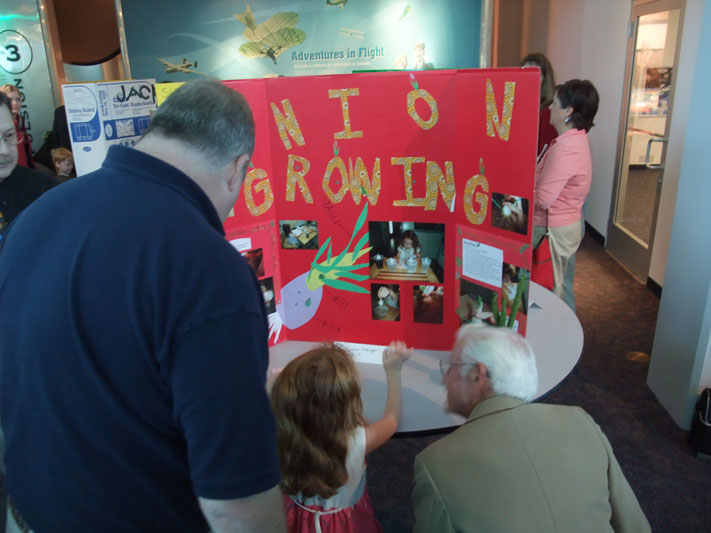
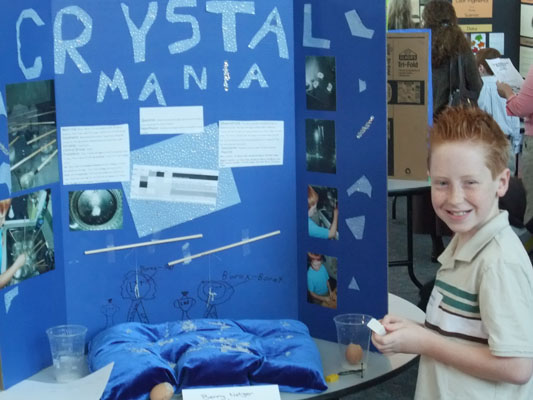
On Monday, November 9th, my children, and Shez's children, and about sixty-five other children, were again engaged in something they really love. The cool thing is, it was something that I love too: thinking, questioning, reasoning, testing, finding out. In short, science! So instead of being the nice supportive mom and nodding mildly while the kid scores a point in sparring, or draws a comic, or climbs a pole, I can listen to my five-year-old talking about her control group, my nine-year-old defining his constants and variables, and let me tell you, *that* is something that gets me excited as a homeschooling mom!

Here's Sadie talking to the judges:


Here's Benny, very proud of his work:


A lot of people have thanked us for doing the work that went into turning out the science fair this year. It was a lot of work, but the excitement in our own kids' faces, and in all the other kids' faces, as they were rushing around from the classes to the judging to the movie, standing proudly beside their projects and explaining their work so articulately to the judges, chattering to each other about the details of their work... made it very worthwhile. Some people are inspired by athletes, artists, musicians. Of course, I'm inspired by those things too. However, I find myself getting really choked up, emotionally touched, at spelling bees, geography bees, and science fairs, than at anything else. The earnest, uncensored nerdiness; the fact that these kids are oblivious to the fact that their interest in science might be considered nerdy; the degree to which these really young children have immersed in their ideas... is very awesome to see!

That being true, I have to say, we absolutely loved every minute of the science fair! We were very lucky to have over a dozen excellent judges, both museum docents and community volunteers, the hospitality of Virginia Air and Space Center staff, who set up really engaging classes and a very cool movie, and generous sponsors who provided great rewards to the kids.

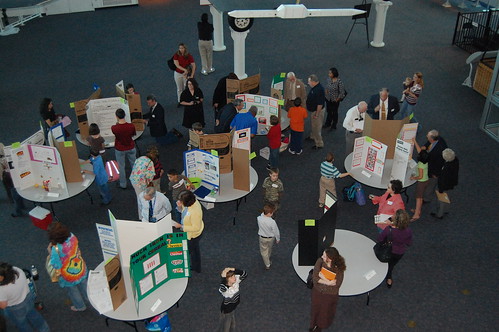
Here's a look at the third and fourth grade projects, as seen from above:


Here are some links where you can find out more:

Our updated web site, where you can find all the results, pictures, links, and info you can handle: GUESS Homeschool Science Fair.

Our Flickr photo pool, where you can see pictures from all angles, from five different moms. GUESS pictures on Flickr.

Our sponsors:

Green Olive Tree
Book Exchange Norfolk
Mad Science of Hampton Roads
eScience Labs
Norfolk Karate Academy
Moore Expressions
Folkmanis Puppets
Brooks Systems
The Happy Scientist
SKS Science
Mariner's Museum
Virginia Air and Space Center

There will be many ways that you can help us bring about GUESS 2010, so stay tuned on the web site and on our blogs for more information.

Friday, May 02, 2008

Hands On Homeschool Science at eScience Labs

Lots of homeschoolers think that when their kids get to high school level science, they have to go to traditional school so that they won't be missing out on labs. I have to admit that I've said stuff like this myself! It's hard to get over the idea that standing in an "official" laboratory with a teacher in a white coat and goggles, among 25 other children who are each holding the same test tube and distilling the same compound, is a necessary experience for a teenager doing science.


Official Product Photo

Fortunately, the people at eScienceLabs have created hands-on science kits for homeschool science students. They generously donated one of their high school biology kits for us to give as first prize in our oldest grade division at the G.U.E.S.S. Homeschool Science Fair, so I was able to take a look and examine the contents of one of these kits. I have a few observations:

1. Everything is divided up meticulously into separate little baggies and boxes, so the experiments and materials are clearly distinguishable and identifiable. This would be on my mind, if I were ordering one of these kits, because I as a homeschool teacher am not necessarily familiar with all the little pieces and parts, and having them separately packaged and labelled is a big relief.

2. They've really thought of everything. From the little connecting beads to make molecule models to the slides and test tubes and little bottles of different chemicals, it looks like all you have to add is the child's brain. Real test tubes, lots of measuring stuff, pipettes, goggles, latex gloves -- it's all in there.


All packed into the box

3. This would actually be a neat present for a kid who's into science. I mean, this is so neat and gadgety and interesting and just looks like something that a child would *love* to dig into and unpack -- I bet for the right kid it would make a great birthday present! Definitely a curriculum that would bring out squeaks of joy and excitement rather than groans and moans.

For a science gift or a homeschool science curriculum, eSciencelabs.com has a great selection of hands on kits that will make science fun for your students and make you feel better about creating a real "lab" experience right at home.

Saturday, April 26, 2008

Building Foundations of Scientific Understanding: A Science Curriculum for K-2 by Dr. Bernard Nebel


Learning science in kindergarten is a privilege that most public school students do not enjoy. Teachers have enough to do teaching them to read and do math and stand in line and answer to bells and wait their turn to speak and print their names properly and wait for paste and line up their crayons in a row. Ironically, the kids probably get more science education in preschool when they do themed unit weeks like weather week or ocean week than they do in the early elementary grades.

That's the kind of science little kids get, when they do get it: topical stuff. Let's learn about fish. Let's learn about plants. We'll learn about fish this week and plants next week, but we're not going to learn about what connects fish to plants or how the sun is connected to both fish and plants, because little kids don't typically get trusted with that kind of information. They aren't asked to see the big picture, draw lines between their thematic units, understand science as a whole, as a system of interconnected disciplines. A privileged first-grader who's getting a bigger-than-average helping of science is going to know the names of the planets and how bees make honey and that their eyes allow them to see, but that's where it stops. I can't honestly say that I've ever seen a whole-world approach to teaching science to young children until I saw Dr. Nebel's books.

His first book was a how-to manual addressing all aspects of elementary education, not just science. As an elementary level homeschool curriculum, it doesn't provide a box of workbooks, but teaches a philosophy of teaching and learning. It's called "Nebel's Elementary Education." Here's a summary, from the web site:

This single book (8 1/2 x 11, 450 pages) contains approaches and actual subject matter for delivering the entirety of a superior K-5 education. It describes not only WHAT to teach, but also HOW to teach it using hundreds of hands-on activities, and much more.

Most distinctive is the organization. Typical elementary curricula consist of an array of stand-alone units, which kids readily forget, confuse, and from which they never gain a full picture. In sharp contrast, Nebel lays out each subject (K-5) as a seamless continuum of lessons integrating different subjects along the way. Simultaneously, Nebel shows you how to guide your children along this pathway in a way that builds logically and systematically toward a broad, comprehensive, holistic understanding. The result is achievement of knowledge, skills, understanding, and problem-solving ability that will provide a solid foundation for all further learning.

The book is in total harmony with modern research concerning the most effective and efficient teaching techniques that bring children to become joyful, self-motivated learners. In short, this book may be considered a breakthrough in translating theory-what leads to the most effective and efficient learning-into a practical curriculum addressing all subjects.


His new book focuses just on science, and is called Building Foundations of Scientific Understanding: A Science Curriculum for K-2. I can't think of a reason why five-year-olds cannot begin to learn and understand science in context, just like they can start learning history at this age, not that they get that in public school either. Dr. Nebel has sponsored the G.U.E.S.S. Science Fair and we're proud to have him on board. We get to give away four copies of his books as prizes at the fair. If you appreciate Dr. Nebel's contribution and want to help spread the love, feel free to snag these images, link to his site, at http://www.pressforlearning.com, or drop him an email to say thanks. Homeschoolers have a special opportunity to start their children on the right path in science education, and Dr. Nebel can help.


Friday, April 25, 2008

Mad Science: Science Classes, Enrichment, and Fun

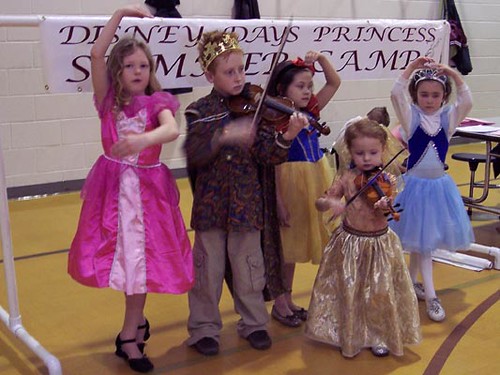
Last week we went to a summer camp expo at Newcastle Elementary down in Virginia Beach. We were invited to come and play and dance and dress-up to support the promotion of the Art of Dance Princess Camp. Sadie wore a princess outfit, Benny wore his prince costume, and both kids played the violin and passed our brochures for Miss Monique. Cuteness:


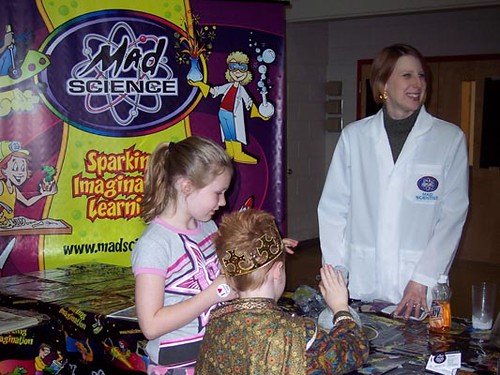
The act that stole the show, however, was Mad Science. This showstopping pair of test-tube-clinkers drew the biggest crowd, wowed the most kids, and created the biggest dry-ice-related spectacle. They were bigger than the live rabbit, better than the peacock feathers -- I think they would have even outshined a free cupcake table. Benny was riveted:


I had never heard of Mad Science until I approached them as a sponsor for the G.U.E.S.S. Homeschool Science Fair. Before I met them, I wasn't sure what they did or why kids would be interested. After I saw their display and watched the children gather, it took about 30 seconds for me to start nodding my head -- I got it. All the children at the expo were gathered around, cheering for the experiments, wanting to get a "vapor shower" and hanging on every word of the pair in the lab coats.


Jen and Heath Marcus are funny, charming, and really knew their stuff. I can't imagine a child being immune to the draw of the oversized beakers, the interesting substances, and the spectacular visuals. So, wonder of wonders, joy of joys, I discovered this week that Mad Science is having a homeschool science class at the Kempsville Library. Of course, after investigating the schedule, I found it's during our ballet class, so we can't go! But you can!

To find out more about it, click here for the flier. This six week class is only $80 and meets on Thursdays from 10:30-11:30. If we weren't in ballet class, we would be there. We will definitely be checking out their offerings for fall and for chemistry summer camp and NASA summer camp. They also do science birthday parties.

Mad Science will be coming to our science fair to do a short demo of their show while the judges deliberate. I can't wait. I'm sure it will be a hoot.