Wednesday, June 02, 2010

Aeneid Class: Week 15: Finale

This post relates to my literature class for children at Homeschool Out of the Box co-op in Norfolk, VA. This semester we are reading The Aeneid, using Penelope Lively's book In Search of a Homeland, and other supplemental materials. For other lessons, please click the Aeneid tag at the bottom of this post.

Welcome: This is our last class meeting! Weep! Our day today consisted of rehearsing for our show, taking our final exam, and performing for the parents. The Junior Aeneid class also made a craft project and reviewed the whole story of the Aeneid. While we retold the story from the beginning, we decorated pinwheels with scenes from the story -- one on each of eight points of the pinwheel. Then we folded them and stuck them onto the ends of Arma Virumque Cano pencils, and blew into them like the winds of history carrying the story into the future.

Final Exam: No more true and false! Today's final exam consisted of 25 questions, some with more than one answer required, and it was really tough! I'm very proud of the kids for their recall, their enthusiasm, and their excellent brains. The final exam was a big success. Everyone who took it got a commemorative Arma Virumque Cano pencil, donated by Ben and Shira!

The Death of Turnus: In the academic track class, we spent some time discussing the end of the Aeneid. The final scene in our book is the death of Turnus, the Latin hero that Aeneas ended up fighting one-on-one to end the battle and establish his place and a place for his descedents in Italy. There they were, facing each other across the battle field, and the whole weight of history was on them. Aeneas threw his spear and wounded Turnus in the leg and he went down. Now, here comes Aeneas, ready to finish him off, ready to wipe out this whole idea that the Latin king had any power over his Trojans and his future. And Turnus looked up at him and asked for mercy, or at least to have his body returned to his father.

We paused the conversation on that moment and I asked the children to consider what they would do in that situation, if they were in Aeneas' position. This is a hard question! We talked about how we in our culture value kindness and mercy, value giving people second chances, how we would not necessarily kill someone who we had subdued and who was asking for mercy. But the Roman ideal, though they valued clementia, was to be strong, to kill fiercely and to die well. As I said to the children, a Roman soldier was not one to say, "Well, Turnus, we've had our differences, but now I've taught you a lesson and you can go on your way."

Even so, Aeneas paused in that moment too. Did he kill Turnus? Yes, he did. But only after he saw the belt of Pallas, the Etruscan prince and his friend who had helped him in the battle. Turnus was wearing it as a trophy, and it caught Aeneas' eye as he hovered over Turnus, weighing that killing blow. So this archetypal Roman killed his enemy without mercy, but he did it not for the gods, or for himself, but for his comrades in arms, for his fellow Romans, and for Rome. We talked about how this motivation was romanticized in "Horatio at the Bridge" in the lines about the Romans being like brothers, in the brave days of old.

So, those ideas about that scene sort of encapsulated everything I have tried to teach the children this semester about the Aeneid: why it was important, what it meant to the Romans at the time when the Empire was expanding, and why Virgil made the choices he made in writing it.

The Finale: Here are some videos from our final performance:

"Let's Get the Heck Out of Troy"


"Dido and Aeneas: I Will Be Roman"


A Demonstration of Roman Virtue:


A Recitation of an Excerpt from "Horatio at the Bridge":


"Friends, Romans, Countrymen"


"Arma Virumque Cano"


I have loved teaching all your children, and hope to see them all back for The Three Musketeers in the fall! Keep reading!

Aeneid Class: Week 14: The Rostra

This post relates to my literature class for children at Homeschool Out of the Box co-op in Norfolk, VA. This semester we are reading The Aeneid, using Penelope Lively's book In Search of a Homeland, and other supplemental materials. For other lessons, please click the Aeneid tag at the bottom of this post.

Rostra: We began our Rostra event immediately, and invited the parents to come up and be populace. We staged the Rostra by pushing tables together in the middle of the room, and attached our Rostra banner to the front of the table. All of us walked around briskly, going "rabble rabble rabble" to approximate the noises of a busy forum if we were in Ancient Rome. Then one by one the kids would take the stage and recite as much of the memory work as they were comfortable reciting. To give you a better idea, here are the videos I put together. I was filming while rabbling, and some of the clips got clipped, messed up in some way, or did not film properly to begin with -- but at least you can get the general idea. All the children were amazing, and I'm very proud of all the hard work they did pulling together the memory work.


Class: Today's quiz was over the Rostra fast facts. We sang our songs, practiced Horatio at the Bridge, and discussed some more of the story of the Aeneid, as Aeneas rallies the Etruscan princes and kings to join the fight against the Latin tribes. Next week is our finale, and we are ready!

Thursday, May 27, 2010

Gamer Birthday Parties at Cybercriter Internet Lounge


If you're female and over the age of 23, you may never have set foot in an establishment called an "interent lounge." I'm about to tell you why you might want to swing that door open wide and walk right in. Now, you may have a certain vision in your mind connected with such a place, involving adolescent males with patchy beards growing to the floor, eyes glazed over, cheese powder flecks crusted to the sides of their mouths, hands clicking rhythmically on their gummy controllers. Maybe the place smells kind of like an old sock, with wires running everywhere, and blinking lights in seizure-inducing rows. Maybe there's Red Bull dripping from the walls. Maybe there are giant alien swords stuck into the cement floor.


Maybe there are places that fit that description, but Cybercriter Internet Lounge (yes, really only one T) in Norfolk, behind the Ted Constant Convocation Center, is not one of them. Let me take you on a tour, and enlighten you. When you walk in, you're in a long but small room with beautiful HD televisions along all the walls. Attached to every console is a game system -- Wii, Playstation, etc. There are windows, and light bulbs, and there is carpeting. There's a counter with snacks and a register. It's all very clean. There are no drooling adolescents. At all.


Now here's the majestic beauty that I want to show you. Imagine you're hosting a birthday party. All along the walls there are clusters of children, eagerly playing games. Some are watching, others playing, they're laughing, yelling "YES!" and "OH MAN!" together, having a ball. There's every child-friendly game on every game system you can imagine. WiiPlay, WiiSports, Guitar Hero, Mario Party, Little Big Planet, and the list goes on. But the magic is the sincere energy and joy and excitement of all the little friends together, trying different games, cheering each other on, locked in battle, and thoroughly, utterly engaged.


We went to CyberCriter for Louis' gamer birthday party, and I was absolutely amazed at how well the kids played together, how much fun they had, and how quiet it was in the room. All the moms had a lovely chat, Deva had set up one counter with snacks and drinks, and it was amazing. I arrived skeptical, and left completely convinced.


Here's the info: $10 per child includes two hours of play time on the consoles. If you want CyberCriter to handle pizza and soda or juice, it's an additional $4 per child. There are spaces and tables for crafts, chips, birthday cakes, etc. You can bring your own games/consoles/whatever to supplement what they have, or just use theirs. They can accommodate between 5 and 20 kids. If you have a gamer in your family who's having a birthday or another special event to organize, this just could be your dream solution!

Wednesday, May 26, 2010

Differentiated Curriculum: What does it mean?


Beyond multiplication tables or the life cycles of frogs, beyond the dates of the Punic wars or the names of the Presidents, the most important thing that we can teach our children as home educators is how to think. Thinking is more than memorizing or reacting -- it's making and recognizing connections in the world. Applying this idea to that situation, translating this concept into that context: that's thinking.

Prufrock Press is a fantastic publisher of curricula and learning materials for gifted children. The most impressive thing about their programs, for me, is the emphasis on teaching the children how to think, encouraging them to make connections, and stretching ideas across the whole spectrum of learning to show them how everything is related, how one idea can apply to many situations.

A perfect example of this kind of teaching is the concept of "differentiated curriculum." What does this phrase mean? Each differentiated program takes one broad concept and applies it to many different situations and contexts across the curriculum. Science, art, literature, history, geography -- all are linked by a common conceptual element.

The unit we bought is called Structures, and it comes in three parts. Here's the description from the Prufrock Press web site:


The Earth is a solid structure on which we live, but it is not unchanging. Forces inside Earth constantly change both the inside and outside of the planet we call home. When students consider the concept of structures, they will discover that the word has many meanings. The Structures Differentiated Curriculum Kit provides exciting activities to help students discover the structures that exist all around them.

The books in Prufrock’s new Differentiated Curriculum Kits employ a differentiated, integrated curriculum based on broad themes. This all-in-one curriculum helps teachers save planning time, ensure compliance with national standards, and most importantly, pique their students’ natural excitement and interest in discovery. By participating in the wide variety of activities in the Differentiated Curriculum Kit for Grade 5, students will discover the structures around them and gain a lifelong desire to learn.


In
Structures Book 1: Geology, Expansion, and the Arts, students will learn that structures can be physical, natural, symbolic, and metaphoric. Students will explore natural bridges, earthquakes, erosion, Westward expansion, the Industrial Revolution, and more. In Structures Book 2: Cultures, Geometry, and Energy, students will explore the origins of popular nursery rhymes, racial barriers, and geometry and architecture. In Structures Book 3: Government, Cycles, and Physics, students will study cycles in time, business, monetary value, electricity, and magenetisim. Each book contains detailed lesson plans, reproducible activity sheets, and assessment tools.


Other books in the series include Systems, Cycles, Frontiers, and more. Here's a link to the page with all the differentiated curriculum. If you're like me, the very idea sets your brain to popping -- what poem, scientific concept, historical event, geographical phenomenon, piece of art, and political system could be linked with the idea of "cycles"? The whole concept of this curriculum is just magical to me, and it seems like an ideal, perfect, absolutely exciting way to engage a child over the summer, or as part of a really cool, integrated year of homeschooling.

Note: There are a lot of assessment materials and reproducible pages -- which makes it seem like it is more intended for classroom use. This would make the material perfect for use in a co-op or a group of friends all learning together. Ancillary materials are used a lot -- books from the library, or stuff you may have in your homeschooling library, to introduce the scientific and historical stuff.

Shurley English Teaches Itself


There are are some areas of the homeschooling curriculum about which I get excited. Literature, for example, really gets my blood flowing and my teeth chattering. I love to learn it, teach it, toss it up in the air and catch it, feed it cookies, babysit its toddlers, etc. History increasingly delights me too, although that surprises me -- I can remember saying "History is so over" to enrage my history major friends. I love working with the kids on music, art, writing. But one thing I do *not* enjoy, one thing I found galling and irritating as a child and feel pointless and tiresome now is GRAMMAR.

My nod to grammar with Benny has been to purchase some kind of floppy, grade-level workbook a few weeks before our yearly test. We mash through it with our noses pinched, and then he knows whatever capitalization or comma rules are appropriate for him to know, and we leave it for another year.

The one place where we have spent some time learning grammar, and the one context in which it seems interesting and relevant, is Latin. As you know, we use Latin for Children from Classical Academic Press, and in teaching the first level this year, I kept hearing about how Latin for Children is designed to fit perfectly with Shurley English, and how a lot of the methods employed are similar, based on the same research. Well, we LOVE Latin for Children -- maybe, just maybe, I could love a grammar program too. As I contemplated starting Sadie in first grade in the fall, I realized that Shurley English might be perfect for her -- so I bought the Level 1 stuff from their homeschooling-specific line, and had a look.

I have to tell you, this stuff teaches itself! One lesson I learned immediately is that unlike many programs, the teacher's manual in Shurley English is essential. It tells you exactly what to do, what to say, how to say it, what pieces of the workbooks and activity books to use, and more. There are chants, songs, and jingles, along with a very methodical approach to teaching elementary grammar. For someone who is uninterested in charting any new courses or blazing any new trails in teaching this particular material, Shurley English is perfect.

Sunday, May 09, 2010

Aeneid Class: Week 13: Aeneas' Shield

This post relates to my literature class for children at Homeschool Out of the Box co-op in Norfolk, VA. This semester we are reading The Aeneid, using Penelope Lively's book In Search of a Homeland, and other supplemental materials. For other lessons, please click the Aeneid tag at the bottom of this post.

Welcome: We are coming to the end of our class! That is sad for me. I have really enjoyed working with your children this semester. We still have a lot to get through in these last few weeks however, including today -- two painting projects to get through!

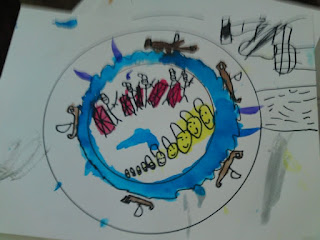
Aeneas' Shield: At the end of the reading assignment for today, Aeneas' mother, Venus, gives him a present. This special shield foretells the future of Rome, including our favorite characters, Julius and Augustus Caesar, of course! Virgil wouldn't want to let a chapter go by without reminding us that the whole point of this epic is to validate the authority of the emperor! Today we are making shields with watercolor. To do this project you will need watercolor paper marked with concentric circles, and watercolor paints. Those children who were in my Jungle Book class last semester were reminded that mandalas come in many forms -- and that concentric circles marked with symmetrical designs are everywhere! Some of the students took up the challenge to make pictures of the founding of the Roman empire, and some did more abstract designs. Here are some examples of their work:


I was particularly impressed with how some of the children in the enrichment class were able to graphically articulate the growth of Rome from one city to a big and powerful empire through assimilation and attack. We've been talking about how the bigger you get, the easier it is to get bigger, either by intimidation or war. It was great seeing that some out on some of the shields!

The shields will be used as programs for next week's Rostra event.

Rostra Banners:

Next week we will be putting on our final big event: Oratory at the Rostra. We created banners to decorate our platforms today. I was absolutely floored by the fact that I had ten children all working collaboratively around a single banner, and in three classes I had no arguing, no "he got paint on my part!" at all. Kudos to these kids, really! Super great job. You'll have to wait to see the banners, because I didn't take pictures yet, but they are... expressive.

Rostra Info:

The children almost all volunteered to take part in the oratory at the Rostra next week. You are invited to attend! It will be held in the classroom. Warning: If you are made nervous or queasy by children standing on tables, please bring the appropriate sedatives for yourself. :) Below are the memory lines they chose to recite. You will find the words they're working on in their scrapbooks, or I'm printing them below. They do NOT need to memorize all of the poem in order to participate. Even one line is fine! I told them even one syllable is fine, actually. Encourage the children to recite only what they're really comfortable reciting -- we want this to be a very positive experience, and that means fewer lines is better, if more lines bring anxiety. Look for your child's name in the list below. If you and your child are not sure what you should be working on, please let me know. If your child's name is not on the list, it means they did not want to participate. All participants will receive a special issue "Rostra" citizenship coin.

Mark Antony's speech at Julius Caesar's funeral: Stephen, Louis, Carrie, Hannah, Nathan, Richard, Benny, Cecelia, Basi, Catherine, David, Sadie.

Aeneid in Latin: Shira, Ben, Sarah M., Martina, Julia, Elsa, Katie, Max, Morgan, Miranda

Horatio at the Bridge (either the first two verses, or the last two verses, or both): Emily, Jillian, Sarah R

Brayton will be the MC at the 9:30 class, and Celia will be the MC at the 10:30. I will MC the Juniors.

Reading Assignment:

Reading for next week is Nisus and Euryalus and The Return of Aeneas. After we finish with our Rostra presentation we will be having regular class with singing, Horatio practice, and a quiz over the Rostra fast facts.

Friday, April 30, 2010

Aeneid Class: Week 11: Horatio at the Bridge

This post relates to my literature class for children at Homeschool Out of the Box co-op in Norfolk, VA. This semester we are reading The Aeneid, using Penelope Lively's book In Search of a Homeland, and other supplemental materials. For other lessons, please click the Aeneid tag at the bottom of this post.

Welcome: Last week was so gloriously exciting that we needed this week to catch up a bit and regroup. We had some recitations to hear, some songs to review, and we needed to get back in touch with the story of the Aeneid.

Underworld Travel Guides: I checked the kids' work on their Underworld Travel Guides (or Underworld Bestiaries) and awarded citizenship coins to those who had finished the job. Some of these kids did absolutely amazing work on their illustrations and showed a great command of the material and real creativity in presenting the information. I hope these will be keepsakes for your child to remember their experience with this text for years to come. When they revisit the Aeneid in college, hopefully they'll remember their first interaction with it, as kids.

Scrapbooking: Speaking of memories, I had photos printed for the children to paste into their scrapbooks. We took some time to do that today, and look back over the activities they did in class: the dinner party, the gladiator games, and the chariot races. Some of them wrote captions and notes for themselves to look back on. I encouraged them to include their own drawings, their own pictures from home, or any other little keepsakes or memories that they might have collected during the class.

Horatio at the Bridge: We've been working on a dramatic recitation of this poem, and today we solidified the parts. There are four individual parts: Consul (Emily, Julia), Horatio (Sarah R, Stephen), Spurius Lartius (Shira, Martina), and Herminius (Louis, Basi). Ask your kids whether they have an individual part, and make sure they know what they are supposed to be reciting. All of us together will recite the first two and last two stanzas.

Reading Assignments: For next week, read The Flames of War and The Future Foretold.

Wednesday, April 28, 2010

Welcome to the New Address!

This blog is now located at http://littleblueschool.blogspot.com/. Please update your bookmarks, tell your friends, throw out your rabbit bedding, and put sticks in your hair!

For feed subscribers, please update your feed subscriptions to
http://littleblueschool.blogspot.com/feeds/posts/default.

Friday, April 23, 2010

Aeneid Class: Week 10: Chariot Races

This post relates to my literature class for children at Homeschool Out of the Box co-op in Norfolk, VA. This semester we are reading The Aeneid, using Penelope Lively's book In Search of a Homeland, and other supplemental materials. For other lessons, please click the Aeneid tag at the bottom of this post.

Welcome: Today we met outside! The weather was beautiful, perfect for our purposes. We sat on the grass and spent a little bit of time taking the quiz on the Underworld. The enrichment class sang through a few of our songs. Then we learned about the Circus Maximus, the organization of a chariot race, and other relevant facts.

Chariot Race Philosophy Lecture: We focused our discussion on one significant difference between our culture and the culture of Ancient Rome, as illustrated by the clip from "Ben Hur." In the old days, if someone fell out of the chariot, do you think the emperor clapped his hands and called a halt to the race? "Hold on guys, let's take a break and make sure that Maximus is ok! Can we get a stretcher out here?" NO! If Maximus fell out of his chariot, that was his own dumb luck, and if his friends managed to drag him out of the way before the horses came around again, good for them. If not, bad for him.

At this point it's important to do whatever is necessary to communicate to your students that you are about to say something very serious. Maybe stand on a chair. Maybe flap your arms around. Maybe glower. Then tell them that in this respect our culture is *VERY DIFFERENT* from the Roman culture. While the Roman's primary interest in chariot races was entertainment (and they found gruesome injuries profoundly entertaining), our primary interest in chariot races is SURVIVAL. Have them say it out loud: SURVIVAL. I actually had each one individually say it back to me. What is the most important thing today? SURVIVAL. And what constitutes survival? Not falling down, not falling out of your chariot, not causing your charioteer to fall out of his/her chariot, not causing your co-horse to fall over.

I told them clearly that we were creating a spectacle, not a real race, and that while no prizes would be awarded for winning, I would be awarding citizenship coins for safe behavior. As it turns out we only had one injury -- one of our horses scraped up her ankle -- and everyone got their citizenship coin. Looking back on the experience, I'm pretty amazed that someone didn't fall in the Hague or something, but we all had helmets on, and you know that often prevents excitement. Right?

Chariot Race Activity:

To carry off a chariot race the way we did, you will need a wide open space, preferably without traffic. We had a low traffic street that we were able to stop the few cars from coming through during the races. You'll need a mom at the start, a mom at the turn, a mom to help the emperor do his/her job, a mom to orchestrate the horn blowers, a mom to man the first aid station, etc. Then you need the following items:

2 large wagons.
8 dog leashes (four on each wagon, two pairs clipped together to harness the "horses")
Safety helmets
Traffic cones
Emperor chair, costume, and a hankerchief to drop to begin the race
Horns (gift paper tubes, pvc pipe, etc)

Here are pictures:


And here's one video:


For many more pictures and videos, please visit the chariot race Flickr set.

As you can see, we had a great time. Thanks to all the parents and helpers that made it a safe and happy experience for the kids, and thanks to all the kids who really adopted a spirit of cooperation and fun. Yay for chariot races!

Friday, April 16, 2010

Explode the Code Blends Phonics and Fun


My mother taught first grade for a million years. In her career, she saw trends in pedagogy come and go, including whole word reading, context support, invented spelling, etc. She was a firm believer in the phonics method, and even hoarded old textbooks, saved phonics-based readers from dumpsters, and rebelled against her school system in order to continue teaching first graders to read with phonics. She believed that all other methods were, to use her word, "bunk."


I know my mother would have loved Explode the Code. It is not flashy, and it is not slick == it is solid, reliable, old-school phonics and it will teach your child to read. In this it reminds me of the Bob Books -- also hand drawn, also based on progressive phonics, also reliable as dirt. Now, for those who love learning on the computer, there's even an online version of Explode the Code, which translates the excellent phonics foundation to a fun, flash-based learning environment. Using the web site independently or together with the workbooks, it's a win win. Go here to explore this new online phonics curriculum.


My daughter Sadie has been struggling with reading for years. She is now six, but since she was four she knew all her letters and the sounds they make. She had the tools, the knowledge, to read first grade material, and yet she would look at a word and say "I can't read." This was extremely frustrating for me as a teacher. I am a book person, my older child is a strong reader, how could this be happening? I'm still not sure exactly what's going on in Sadie's head when she says "I can't read." I think it might have to do with her persistent suspicion that if she learns to read we'll send her to college.
Explode the Code workbooks and online games have been miraculous for her. The repetition, the spiralling returns to familiar material, the very very slow steps forward accompanied by many iterations of the words the child can confidently do, have made it absolutely impossible for her to tell herself she can't read. She can. It's undeniable. The words she knows with Explode the Code she knows inside out, upside down, backwards, and sideways. When she looks at me, shocked, and says, "I can read that!" it's amazing! Explode the Code works for us, and if you have a brand new reader that needs the confidence that comes from practice, I bet it will work for you too!