Friday, October 23, 2009

Latin Club Week 7


This is a class report for week 7 of my Latin class at Homeschool Out of the Box co-op. Our textbook is Latin for Children Level A from Classial Academic Press.

Meet and greet. I collected homework and we took the quiz. I speculated that maybe by week eleventeen the children might be accustomed to putting their names on things when they hand them in. I am holding onto that hope, anyway! Hehehe.

Songs. We sang our usual songs, with special emphasis on the second verse of "She Will Be Latin" which contains the second declension masculine verbs that we have been working on so diligently this week.

Translation: I gave the kids copies of Adeste Fideles. You'll notice that the English translation is below the Latin. We sang it in English, gave it a bash in Latin, and then we spent some time figuring out what the Latin words meant and how they corresponded with the English words. We got through the first verse, and the kids were AMAZING at doing this translation work. They were able to identify which words were nouns, which were verbs, and were able to work out the meanings of most of the words, either by using what they knew of Latin already, or by identifying the familiar roots, or by guessing. It was really fantastic. We're going to do the next verse next week.

Stamp: Today's stamp was the second declension noun, ludus, and most of the kids nailed it. A few need to review it. Things are starting to get pretty intense now that we have two different kids of nouns to work on, and our vocabularies are expanding each week. Latin for Children has published a set of supplemental activities -- quizzes, tests, worksheets, etc. that you can find here: Latin worksheets. It's a PDF. I suggest using those in conjunction with the workbooks to help the kids really nail this material.

Hot Seat: From the time they entered the room I was hearing clamors for "Hot Seat" so we played it! Several people were incinerated by the relentless flames of the hot seat, and several people managed to survive and get new hot seat stickers on their folders. Very exciting game. Much laughing. I'm impressed by the bravery of these kids -- they are all willing to take the hot seat every week, even though they are not wearing flame-resistant pants.

Homework: Moving on to Chapter 7! Please do all activities in the workbook and activity book and be ready to take the quiz. If you want to look over the Adeste Fideles sheet and the Aeneid sheet and try picking out some words they know, that would be awesome. Be very very positive over whatever they identify and translate. I am likening it to knowing a secret code; they seem to like that.

Jungle Book Week 7: How to Make a Sari for a Doll


Namaste.

Today we got right down to business because we had so much fun stuff to do with our Sharpie Saris. However, in the academic track class, we made the time to take our Punjab region quiz:

Quiz: Which one of the following statements are true?

1. The word Punjab comes from the Latin and means “The Eleven Diapers.”
2. The Indus Valley Civilization is largely a mystery because we don't understand their writing.
3. When Aryan people migrated to India and practiced an early version of the Hindu religion, that was the Vedic Civilization.
4. The most important idea for Punjabi people is peace and harmony for all.
5. The Punjab has been invaded by a lot of civilizations, like Greeks, Mongols, and the British.
6. Sikhism is a religion that was started in the Punjab and is still practiced there today.
7. The British Empire was never able to conquer the Punjab region, so they finally gave up and went home.
8. The Punjab is now fully contained in the modern country of Pakistan. None of it is left as part of India.
9. Bhangra dance is a folk dance from the Punjab.
10. Punjabi is the language of the Punjab.

Project: Sharpie Saris

Materials:
Each child needs a doll or stuffed animal.
Sharpies in all colors. Blue and red spread the best -- the "old school" blue and red colors, not the newfangled ones. Of course, we had a rainbow of newfangled colors on hand too.
Stretch poplin cut to fit different sized dolls and animals. The fabric I chose had a small percentage of spandex in it -- this really helps with the pleating and tucking and wrapping. Each piece should be long enough to reach from armpit to floor, and long enough to go around five times. More if you're going to do pleats at the waist. Some of the girls did American Girl saris, and for these I used 44 inches of fabric, the full width of the fabric on the bolt. The width of the strip was about 10 inches. For a Groovy Girls size doll or a Webkinz, you need about half as much length, 2/3 as much width.
Safety pins for pinning the sari at the back.
Rubbing alcohol.
A squirt bottle or spray bottle, or an eye dropper. Fill this with the alcohol.

Instructions:
Find a place outside on the sidewalk or inside with lots of ventilation and a protected surface.
First, decorate your blank sari with the Sharpies. You can do whatever designs you like, but try using some of the motifs we learned about in class -- tear drops, half-moons, stars. You could even decorate your sari with mandalas like this:


Or you could do stripes like this:


Next, making sure you're on a protected surface or one you can ruin, spray the alcohol all over your design. The colors will start to bleed together:


When you've doused it with alcohol, let it dry. Running around waving it in the sunshine is a good way to execute this part of the plan!

When it's dry, wrap the sari on your doll according to the instructions on this video:


Now your doll has a sari:


Here are some pictures from our sari making!


For more pictures, visit our Jungle Book Flickr photo set.

Homework: Because we were upstairs, downstairs, outside, and all around, I'm not sure everyone got the Himalaya and Sannyasi fast facts, or if they got them, I'm not sure they made it into the folders. For this reason, and also because we have a special guest coming next week, we will push the quiz on the Himalayas to the following week. So, there is no quiz this week, there is no reading assignment for this week, and on Tuesday I will make sure everyone has the facts. Also on Tuesday, we will start the Mowgli stories! Hooray!

Friday, October 16, 2009

Latin Club Week 6


This is a class report for week 6 of my Latin class at Homeschool Out of the Box co-op. Our textbook is Latin for Children Level A from Classial Academic Press.

Meet and greet. I collected homework.

Chants. We took turns leading the chants from chapter 1, chapter 2, and chapter 3, and chapter 4.

Songs. We sang Ballad of the Latin Verbs, She Will be Latin, and Dona Nobis Pacem. With extra time, we were able to work on Dona Nobis Pacem as a round. Here are a few video links that the kids can check out, to help them understand how the parts work together: Dona Nobis Pacem on ocarinas. A kids' choir singing it Dona Nobis Pacem.

Games. Today since there was no quiz, we played many games.

Around the room: We sit in a circle, and take turns each saying one part of the noun declension, sending the noun around the room. This is surprisingly difficult as we get to nouns that we haven't heard declined out loud. Also as we go faster.

Stepping Up with Verbs: Person A sits on the floor, person B sits on a chair beside her, person C stands next to him, person D stands on a chair. So there's a graduated height as the four students are all standing in a line. Then we start saying the principle parts of the verbs -- person A whispers the present, person B says the infinitive, person C loudly declares the past, and person D hollers the passive participle as loudly as decorum will allow. That was pretty hilarious, especially when Travis was standing on the chair.

Strangely, we did not have time to play Hot Seat or work with our flashcards. I don't know where the time goes once you start shoveling up the nouns and verbs.

Stamps. We had a surprise stamp today which everyone got: identify the principle parts of any verb.

Assignments. Please do chapter six in the primer and activity book and review all vocab! We will do the quiz from chapter 6, and the stamp chant will be the "ludus" chant: second declension masculine noun endings: ludus, ludi, ludo, ludum, ludo, ludi, ludorum, ludis, ludos, ludis. See you Tuesday!

Thursday, October 15, 2009

Jungle Book Week 6


Namaste.

We may have started the enrichment track class with an India dance party. We may have also ended it that way. The academic class, however, started with a very serious quiz. And ended with an Indian dance party. Rawr!

Quiz: Which one of the following statements are true?

1. The word “mandala” comes from the Sanskrit word for “circle.”
2. A circle shape only appears in manmade forms like dinner plates and bike tires.
3. People look at mandalas to give them great ideas for wallpaper designs.
4. People make mandalas to release their inner creativity.
5. Ether is a mixture of the other four elements.
6. Fire is represented by a droplet shape.
7. After making a sand mandala, the artists sweep it all away.
8. Concentric circles share a center.
9. A motif is a small, pear-flavored pastry found in bakeries in Lahore.
10. A symmetrical design is the same on both sides.

Bonus #1: Name one place where a circle with a radiating design appears in nature.

Bonus #2: Draw the shapes that represent water, air and ether.

Presentations: Ben presented on wolves, and Shira presented on horses. Both gave short talks, included jokes, held everyone's attention well, and used props. Ben showed a picture of red wolves, and Shira had some grooming brushes to show. Great job to both!

Songs: We worked on all four of our songs. I am asking the academic class to help me rearrange the verses of the "Beaches of Lukannon" song so they can feel they have a little ownership in the way the song is put together. The younger group is not going to be working on that song for now -- I may bring it back in when we have the other three more solid.

Punjab Region: The story "The Undertakers" takes place in the Punjab. It was very very hard to reduce the history and culture of this region to ten "fast facts" for the quiz! The most important thing is that I want the students to get a sense of how complicated and multi-textured the culture of the region is. This is a product of all of the invasions and the many times the region has been conquered by different empires. One of these empires was the Sassanid Empire (remember them, Arabian Nights parents?) and one was the Mughal Empire, which we are reading about in the Salman Rushdie novel. So, in some ways the region is a mad pastiche of many different cultures, but it has also developed a strong identity of its own -- its own religion, its own language, art, dance. Next week we'll be moving across the North of the country from the Punjab toward the Himalayas in "The Miracle of Purun Bhagat."

Sari: I demonstrated draping a sari with a piece of fabric I brought, to give them the idea of what one might look like. Next week we will be making saris for dolls or stuffed animals. I will bring the sari fabric and the decorating materials. Your child should bring a doll or stuffed animal to dress. American Girl dolls would be perfect, regular size WebKinz would be perfect. It would be more difficult to drape a sari on a stuffed dolphin or worm or something without shoulders or arms, but we will work with whatever you bring! I mentioned to the girls that if they have enough yardage at home to make a sari for themselves, they can bring that, but this is not mandatory or expected. It takes at least three yards. Want to practice at home? Here is a helpful video:


Little Babaji: The enrichment track heard the story Little Babaji. This is a folk tale from India that you might have heard long ago as "Little Black Sambo." When I was little we used to go to a restaurant in Detroit that was named after this story. This title was a racist way to label what is essentially an Indian story. The British referred to Indian people as "blacks" and "Sambo" was an insultingly reductive name -- obviously not a name that originated in India. The story itself is charming, though, and has been retold by Helen Bannerman with proper Indian names. They really enjoyed it and the illustrations showed some examples of native dress which worked well with our sari discussion.

Bhangra Dance: Bhangra began as the folk dance of the Punjab region, then became pop, blended with some elements of hip hop, reggae, and became more mainstream. Some has a faster, more pop beat:


Some is more comparable to reggae. I'll be making some music tracks available to those who are enrolled in the class. Ask your kids to show them some of their moves! We're excited to be visited by the Bhangra Maniacs from ODU sometime in November, but for now they're stuck with me!

Bonus links for next week:

Bhangra dancers on stage. Note the Sikh headgear.

Kids doing a Bhangra dance. You can find tons more Bhangra videos including how to, demos, and even a Bhangra exercise video.

A few barasingha deer with their huge antlers, like Purun Bhagat befriended in the story.

Purun Dass becomes a Hindu monk, a Sunnyasin, as seen here. Here's a Hindu monk meditating, with a begging cup.

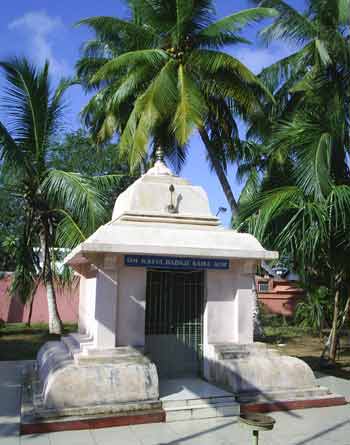
Here is a mountaintop shrine to Kali. Another smaller shrine.

Some pictures from the Indian Himalayas: 1. 2. Lots of Indian Himalaya pictures. More Himalayan pictures.

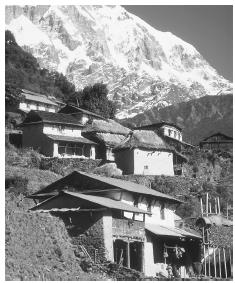
A village built on a hill in the Himalayas. A village building after a mudslide.

Sunday, October 11, 2009

Jungle Book Week 5


Namaste.

Today we had so much to do that we immediately launched into the quiz. The quiz was a blank version of the Fast Facts map, which the children had to fill in, matching the name with the ten locations we learned from Kotick's travels.

Quiz: Do you know these places?

1. St. Paul's Island
2. Juan Fernandez Islands
3. Kerguelen Island
4. Galapagos Islands
5. Georgia Islands
6. Orkney Islands
7. Cape of Good Hope
8. Emerald Island
9. Gough's Island
10. Pacific Ocean

Songs: After the quiz, we sang our songs. We now have four: Mandalay, If, The Beaches of Lukannon, and Jungle Book TV Theme Song. We are getting Mandalay and If memorized, holla! Almost everyone has the first verse down, most people have the second verse down too, and we're working on the third verses now.

Story: I didn't have a whole lot to say about the story this week. Its main purpose was to show the seal hunting from the other side of the harpoon, to illustrate the need that the Aleut people had for seals, and to think about the fact that Kipling could show both sides of this killing with such dispassionate detail.

Mandalas: We learned about the five elements in Indian art: earth, air, fire, water, and ether. We learned how they are represented by motifs: square, half-moon, triangle, circle, and teardrop. Ether is the most interesting element -- ask your child what it is! Ether is the empty space wherein all the other elements exist -- it's coldness, absence, space, openness. We learned how people make mandalas as a mental exercise, and how they focus on mandalas during meditation to help them clear their minds. We also talked about how mandalas are transient. I described sand mandalas to them, but it would really be helpful if they could see a few videos:


Project:

Materials: thick watercolor paper with black circles outlined in Sharpie. Liquid watercolors in gold, silver, black, and a variety of other colors. Paint brushes, plastic egg cartons for colors and mixing. Have plenty of extra "blanks" in case some children want to start over or make multiple mandalas. Plan to have 3 sheets of watercolor paper per child at least.

Directions: First, quiet your mind and look at your mandala. It is not empty! It is full of ether. This means it holds infinite possibilities. Try and let your mandala tell you what it wants in it before you begin to paint. Then paint whatever you like. There is no wrong way to do it, and no right way to do it. Whatever is in your mind can come out in your mandala. (In the academic class, Evan led us in a few "om" chants while we were gazing at our mandalas that were full of possibilities).


Assignment: The story for next week is The Undertakers. We are going to be learning about the Punjab region this week. The story is a little rough to get through, a lot of dialogue and not a lot of action. Skipping ahead a bit for the little ones is perfectly fine. Here are some links for them to look at regarding crocodiles, the Punjab region, and adjutant cranes:

A page about Indian crocodiles.

Photo of a big old Indian crocodile.

Video footage of the Adjutant crane (stork).

Video of local people feeding wild jackals in India.

Saturday, October 10, 2009

Latin Club Week 5


This is a class report for week 4 of my Latin class at Homeschool Out of the Box co-op. Our textbook is Latin for Children Level A.

In class:

Meet and greet. I collected homework and we took the quiz.

Chants. We took turns leading the chants from chapter 1, chapter 2, and chapter 3, and chapter 4.

Songs. We sang Ballad of the Latin Verbs, She Will be Latin, and Dona Nobis Pacem.

Stamps. Great news! Everyone got their stamp today, and the missing stamps from last week were filled in joyously and successfully. There is no stamp for next week, because next week is chapter 5 and chapter 5 is review. There is no quiz either. The children voted to have it be a fun week of games and review and hijinks. So that's what it will be! I am, however, planning to surprise them with an "extra" review stamp, which will be to give the four principle parts of any verb. They should all be able to knock out that one easily.

Games. We played a new game today called Hot Seat. One person sat in the hot seat and we called out nouns for them to decline. If they correctly declined the noun, they got to stay in the seat. If not, the flames consumed them and they were dramatically incinerated. Good times! If one person stayed in the hot seat for five nouns they were liberated and received a hot seat sticker on their folders. This game was very fun!

Memory Work. I found this neat video to help us learn our memory work from the beginning of the Aeneid. This covers the first seven lines. Because we're going to have some time on Tuesday, we're going to work on this assignment a lot, so please have them watch this video.


Assignments. Please do chapter five in the primer and activity book and review all vocab! See you Tuesday!

Thursday, October 01, 2009

Latin Club Week 4


This is a class report for week 4 of my Latin class at Homeschool Out of the Box co-op. Our textbook is Latin for Children Level A.

In class:

Meet and greet. I collected homework and we took the quiz.

Chants. We took turns leading the chants from chapter 1, chapter 2, and chapter 3.

Songs. We worked on our song "She Will Be Latin." This song was particularly relevant today because our chant for a stamp was the mensa chant, our favorite first declension noun.

Games: We played a game where we sent the first declension noun "mensa" around the room, with each person saying one form of the noun. This was very challenging! We're going to continue working on this until we get it very very fast and automatic. Having a person "be" the ablative singular, or "be" the accusative plural, helps us visualize the information and also .

Stamps. Today was the first time anyone had difficulty with the assigned chant, and several children did. If your child feels unprepared on any given day, it's fine to opt out of trying for the stamp. The way I present it is to say "Would anyone like to try for the stamp today?" If at any point you find yourself falling behind in the book, please don't stress. The most important things are the chants. If you listen to the CD a lot, play games with the chants, and repeat them every day, they should be fine!

Memory Work: I passed out copies of the opening to the Aeneid, the invocation to the Muse, in Latin and English. The chapter maxim for chapter 3 is the first three words, and now we have the first dozen lines. The work we're doing is very rules and lists oriented, and I would like them to see some Latin "in action" in the context of this epic poem. Please do not stress about memorizing this at home; we will play with it in class.

Assignments. Great job on the assignments and quizzes! Please remember to send a page to turn in with your kids each week, either from the activity book or the primer. Of course, there is no penalty for not turning in homework.

Thanks!

Wednesday, September 30, 2009

Jungle Book Week 4


Namaste.

Today to warm up, we practiced our Johar greeting. We're getting fast, but I know we can be faster. I attribute our slowness to extreme giggling caused by people calling each other the wrong name. Which never fails to amuse.

Quiz:

1. Hindus believe in one god, which means they are polytheists.

2. The Greeks had a pantheon, the Romans had a pantheon, and the Hindus have a pantheon.

3. A trinity is a type of drink popular in Goa, a coastal city of Southern India.

4. Brahma is the creator, Ganesha is the preserver, and Zeus is the destroyer.

5. Even though there are many gods in the pantheon, many Hindus believe they are all different manifestations of the same idea of god.

6. An avatar is a divine incarnation, which means a part of god that appears on earth.

7. Devas are people who think they are very important to a religion, and act bossy and rude, mostly found in New York and Los Angeles.

8. Ganesha, the elephant-headed god of overcoming obstacles, is one of the most popular gods in the pantheon.

9. Mother goddesses are important to Hindus. Some major ones are Lakshmi, Parvati, and Kali.

10. There is only one version of Hindu. Anyone practicing a variation has to be reincarnated as a pickle.

If you want the answers, ask your child. I'll give you a hint: The pickle one is FALSE.

Songs: After the quiz, we sang our songs, "If," "Mandalay," and "Jungle Book TV Theme." The enrichment class boogied like it was their job.

The White Seal: We had three teaching points today.

1. Point of view. The White Seal is in the point of view of the animals again, like Rikki Tikki Tavi. I asked the children why Kipling chose to write from this perspective, and we talked about how the story illuminates this secret world of seals, which could never have been narrated from the perspective of humans. I introduced the idea that will become much more important later in the Mowgli stories, that Kipling adds layers of law and order over a "society" that is generally seen as lawless and therefore inferior. So where we see a bunch of unruly seals rolling around on the beach, Kipling sees these rich relationships full of culture and tradition. This will relate later to imperialist attitudes toward native populations.

I asked the kids whether the Aleuts who killed the seals were wrong to do it. They all said yes. Then I asked them to imagine the same scene told from the perspective of the humans. For the younger class, I started to tell a story about a boy living in the harsh environment of this Alaskan island, fighting for survival, trying to get clothes, blankets, and tents for his family, oil to burn in their lamps, food to eat, life from these seals. Would that boy be wrong to kill seals to save his family? So, it gets murky. One child asked, "Why can't they just kill and eat the fish?" I asked if they could imagine a story told from the point of view of fish, that would make a reader think that killing fish was wrong. They said no, but I pointed out Finding Nemo and reminded them of the scene at the end with the fishing boat and the "Swim down together!" They started to get my point!

2. The power of fiction. The lesson of The White Seal is not so much about seals and Aleuts and saving your people and arctic adventure and more about how fiction works to make us *feel* about an issue, rather than thinking about it. I asked the children to tell me how the seal killing made them feel: sad, bad, worried, afraid, etc. Creating feelings in a reader by telling the story of a character the reader cares about can be a much more direct route to a reader's opinion than a non-fiction essay that invites argument. We talked about different works of fiction that were written to make a point, and one child brought up Misty of Chincoteague, which is a great example of changing readers' minds with fiction on a massive scale that could never be accomplished (in my opinion) without a character and a narrative.

3. Is killing seals wrong? We talked around the question for a while, and different children talked about their different levels of vegetarianism or veganism. For me, as usual, it's less about the issue and more about the literary artifice, and teaching the children how changing the point of view can radically affect the story's message, and how authors make these decisions based on what they want to make the reader feel. Identifying and evaluating the point of view is one of the first steps in becoming a conscious reader. Have you guessed that our next story is about seal hunting from the point of view of an Aleutian boy?

New Song: We learned "Lukannon," which Kipling says is the seal national anthem. It's a sad, angry song... this will be the last poem we memorize this semester.

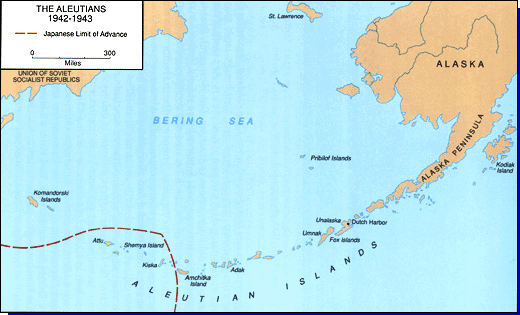
Assignment: The fast facts for this week are all over a map of the world. I made a map of ten of the places Kotick travelled in his search for the island without men. On the map your child brought home, you'll see ten locations labelled, which we went over in class. Next week's quiz will be a blank map, and they'll fill in the numbers for me. The reading assignment for next week is "Quiquern."

Links:

A map of the Aleutian Islands.

A cool volcano in the Aleutian Islands.

A picture of Aleut clothing.

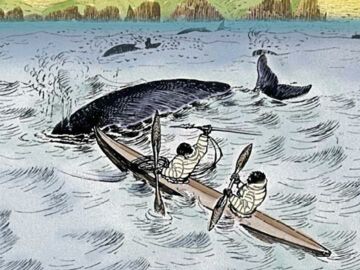
Aleuts in a kayak hunting whale.

Dog sled pictures: 1. 2. 3.

Wednesday, September 23, 2009

Jungle Book Week 3


Namaste.

Decorated Elephants Art Project. Because our project was so involved and I wanted the children to have the maximum amount of time possible to work on it, we started right away.

Each student started with a blank elephant outlined on a half sheet of black posterboard in gel marker:


Materials:

Blank elephants on black posterboard
Gel markers
Chalk
Colored rhinestones
Fabric flowers
Shimmery shapes
Wooden tiles
Cardboard tiles
Sequins of all shapes and sizes
Bottles of Tacky glue

The only instructions: Outline with markers. Color with chalk. Use glue in dots only. No big piles of glue, no glue lines, no puddles, no glops. Dots only. Demonstrate. Dots of glue is the secret of success with this project!

Here are some examples of our finished work:


Here is a link to tons more images of my adorable students and their work.

Songs. While we did our projects, we sang our songs, and many of the students have memorized the first verse of If and the first verse of Mandalay. This is exciting! We moved on to working on the second verses.

Quiz. Here it is -- see how you do! Which of these statements are true?

1. The white man in charge of the elephant capture operation is called a mahout.

2. An elephant works with many mahouts in the course of his life, because it’s dangerous for an animal to become attached to one person.

3. A mahout can communicate orders to an elephant with a word or a touch.

4. The difficult terrain in Northeast India makes it necessary to use elephants for work.

5. Elephants cannot be used to carry guns because they have a strong pacifist ethic and will not move forward carrying weapons.

6. If you were a king or a celebrity in India, you would probably ride an elephant in a parade.

7. Elephants in parades are decorated with black shawls, black yarn wigs, and coal dust, to remind everyone of night.

8. During a khedda capture, elephants are driven into large pools of warm milk, which makes them sleepy and easy to work with.

9. Tame elephants are used to calm down wild elephants that are being captured to tame.

10. Ganesha is a Hindu god with an elephant head.

If you want the answers, ask your child.

Toomai of the Elephants: We had three teaching points today.

1. Point of view. The story "Rikki Tikki Tavi" was in the point of view of the animals, and we could hear the animals talking and see the world from their perspective. "Toomai of the Elephants" is in the point of view of the humans, and we see the elephants from the outside. I asked the students why they thought this might be, and they came up with some interesting thoughts. For example, Sarah pointed out that if we heard from the elephants POV, we would know that the dance was real from the beginning. I asked them why they thought Kala Nag came back to the camp, after the dance was over. To me, this is one of the big mysteries of the story, and one of the most important elements. If we heard from Kala Nag, if we could hear him talk, we would know the answer definitively, but without that perspective, we have to guess. Several of the children thought Kala Nag might be coming back to return Little Toomai -- I thought that was interesting. Others suggested that he was afraid to be free in the forest after being a tame elephant all his life.

2. I asked the students if they could think of ways that Toomai and Kala Nag were similar. The answer I was looking for was the fact that they both drummed to express themselves and communicate with the world -- Toomai on his tom-tom and Kala Nag in the elephant dance. They did give me that answer, but Abigail also pointed out that Toomai and Kala Nag were both kind of caught in their circumstances, servants and enslaved -- the elephant in his ropes and pickets and Toomai by his station in life. I thought this was very insightful and it was exactly what I was getting to with my line of questioning.

3. I told the children that there were was a line in the story that bothered me: "Native children have no nerves to speak of." We discussed what that line might mean, and I told them I found it wrong and sad: All children have nerves. We talked about the fact that in colonizing another country, the dominant culture has to define the dominated culture as less important, less valuable than themselves, to allow themselves to use them and oppress them. We looked at this line as an example of the British "Sahib" making it possible to treat these children poorly. We can absolutely see this as wrong, but we have to ask where this sentiment is coming from. Is it the character's sentiment or is it the author's sentiment? I told them that I wasn't sure whether this was Kipling's idea or Sahib Petersen's idea, and that this was a question we would look into further as we went deeper into the book.

Assignment: The fast facts for this week cover the Hindu pantheon. The reading assignment for next week is "The White Seal."

Links:

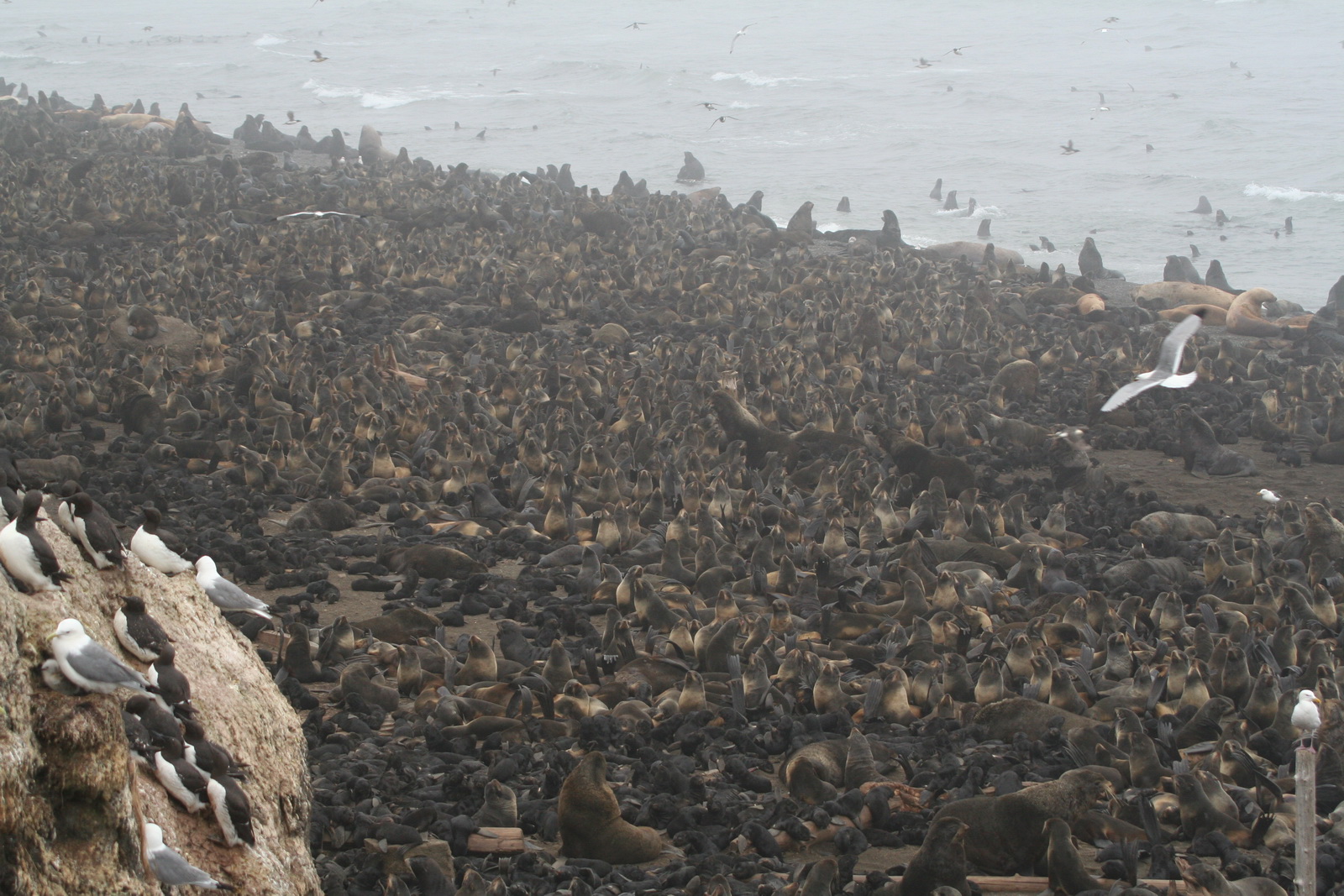
A fur seal rookery.

A northern fur seal, showing its sharp teeth.

In case anyone is interested in some serious information about fur seals, here is some.

Fur seals on Enchanted Learning.

More fur seals with a big bull in the front and center.

Video of a female seal finding her pup in a group, just like Kotick and his mom.

Baby fur seal and his mom.

The White Seal animated movie (by Chuck Jones) Part I
The White Seal animated movie Part II
The White Seal animated movie Part III

Warning: Do NOT let your child search around on YouTube or Google for fur seal links without you. There are extremely disturbing images and videos of seal culls, and the fur trade. Not appropriate for children AT ALL. Like, nightmares for life type stuff.

Latin Club Week 3


This is a class report for week 2 of my Latin class at Homeschool Out of the Box co-op. Our textbook is Latin for Children Level A.

In class:

Meet and greet. I collected homework and we took the quiz. Everyone was faster this week -- much faster! Great job.

Chants. We took turns leading the chants from chapter 1 and chapter 2.

Songs. We worked on "Ballad of the Latin Verbs," "She Will Be Latin," and "Dona Nobis Pacem." I passed out the sheet music for "Dona Nobis Pacem" and encouraged those who play instruments to try it out at home. We have some strong singers in the group! I think we are going to be able to do this one as a round.

Games: In our first game, the leader would say the first part of the noun chant (aqua, aquae) and the group would say the second part (water, water). The trick was to mix us up and take the words out of order so we had to translate instantly without knowing what was next. It was challenging for the group to come up with the right definition, and challenging for the leaders to keep the nouns coming in the right rhythm, without pausing to think.

Our second game involved verbs. I called out a verb, and the students had to stand up for singular, sit down for plural. We stayed with the five verbs in the first chapter, but listening to the different endings and figuring out the number was a challenge. Sometimes they knew right away, and all agreed. Sometimes they didn't agree. It was interesting! We talked about different ways that we memorize these endings -- some remember visually by imagining the chart and what it looks like. Some remember aurally, by reciting the chants silently in their brains. Figuring out the way you learn is a great way to use study time more efficiently, so they should be thinking about this question: How do I remember?

Stamps. We all successfully got our -o/-s/-t/-mus/-tis/-nt stamp, although some of us had left folders at home and got a stamp on the hand instead. Next week's stamp is the first declension noun chant, with the noun mensa. This one is a little harder than the last one and will take some practice.

Assignments. Great job on the assignments! I returned the quizzes and homework this week with some comments and stickers to encourage them to press on in the book. Please have your children ready to turn in a page from the chapter 3 material, either the Primer or the Activity Book. Any page, or a photocopy, is going to work.

Thanks!